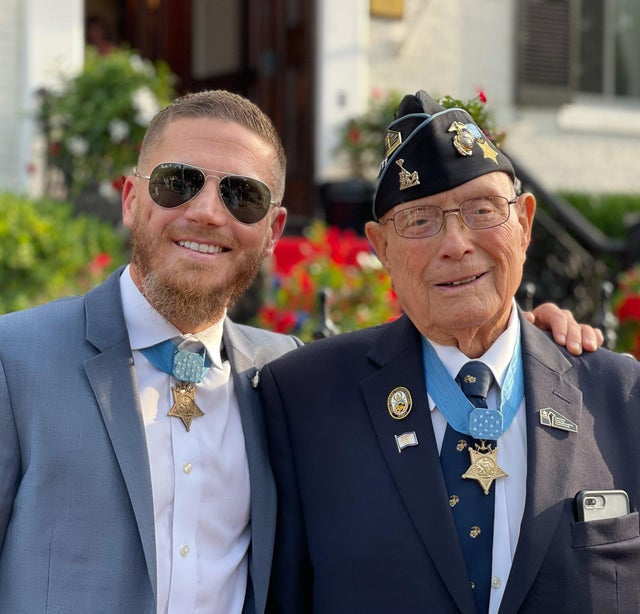
Here is Hershel Williams Medal of Honor citation signed by Harry Truman: “For conspicuous gallantry and intrepidity at the risk of his life above and beyond the call of duty as Demolition Sergeant serving with the First Battalion, Twenty-First Marines, Third Marine Division, in action against enemy Japanese forces on Iwo Jima, Volcano Island, 23 February 1945. Quick to volunteer his services when our tanks were maneuvering vainly to open a lane for the infantry through the network of reinforced concrete pillboxes, buried mines and black, volcanic sands, Corporal Williams daringly went forward alone to attempt the reduction of devastating machine-gun fire from the unyielding positions. Covered only by four riflemen, he fought desperately for four hours under terrific enemy small-arms fire and repeatedly returned to his own lines to prepare demolition charges and obtain serviced flame throwers, struggling back, frequently to the rear of hostile emplacements, to wipe out one position after another. On one occasion he daringly mounted a pillbox to insert the nozzle of his flame thrower through the air vent, kill the occupants and silence the gun; on another he grimly charged enemy riflemen who attempted to stop him with bayonets and destroyed them with a burst of flame from his weapon. His unyielding determination and extraordinary heroism in the face of ruthless enemy resistance were directly instrumental in neutralizing one of the most fanatically defended Japanese strong points encountered by his regiment and aided in enabling his company to reach its objective. Corporal Williams’ aggressive fighting spirit and valiant devotion to duty throughout this fiercely contested action sustain and enhance the highest traditions of the United States Naval Service.”
***
Lance Corporal William “Kyle” Carpenter, United States Marine Corps, for conspicuous gallantry and intrepidity at the risk of his life above and beyond the call of duty while serving as an Automatic Rifleman with Company F, 2d Battalion, 9th Marines, Regimental Combat Team 1, 1st Marine Division (Forward), 1 Marine Expeditionary Force (Forward), in Helmand Province, Afghanistan in support of Operation Enduring Freedom on 21 November 2010. Lance Corporal Carpenter was a member of a platoon-sized coalition force, comprised of two reinforced Marine squads partnered with an Afghan National Army squad. The platoon had established Patrol Base Dakota two days earlier in a small village in the Marjah District in order to disrupt enemy activity and provide security for the local Afghan population. Lance Corporal Carpenter and a fellow Marine were manning a rooftop security position on the perimeter of Patrol Base Dakota when the enemy initiated a daylight attack with hand grenades, one of which landed inside their sandbagged position. Without hesitation, and with complete disregard for his own safety, Lance Corporal Carpenter moved toward the grenade in an attempt to shield his fellow Marine from the deadly blast. When the grenade detonated, his body absorbed the brunt of the blast, severely wounding him, but saving the life of his fellow Marine. By his undaunted courage, bold fighting spirit, and unwavering devotion to duty in the face of almost certain death, Lance Corporal Carpenter reflected great credit upon himself and upheld the highest traditions of the Marine Corps and the United States Naval Service.”
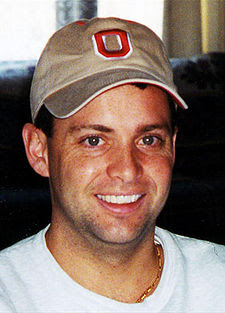
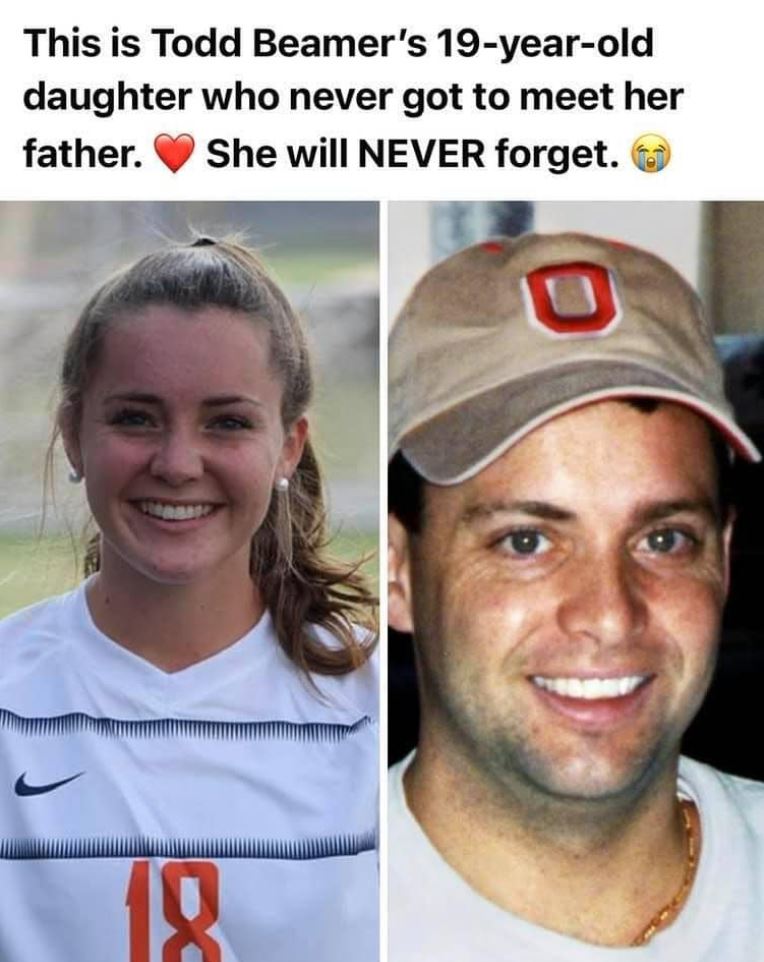
This is the word-for-word transcript of Todd’s phone call reporting the hijacking of Flight 93.
Todd: Hello… Operator…listen to me…I can’t speak very loud. – This is an emergency. I’m a passenger on a United flight to San Francisco.. We have a situation here….Our plane has been hijacked…..can you understand me?
Lisa: (exhaling a deep breath to herself) I understand… Can the hijackers see you talking on the phone?
Todd: No
Lisa: Can you tell me how many hijackers are on the plane?
Todd: There are three that we know of.
Lisa: Can you see any weapons? What kind of weapons do they have?
Todd: Yes…. they don’t have guns….they have knives – they took over the plane with knives.
Lisa: Do you mean…like steak knives?
Todd: No, these are razor knives…like box cutters.
Lisa: Can you tell what country these people are from?
Todd: No…..I don’t know. They sound like they’re from the mid-east.
Lisa: Have they said what they want?
Todd: Someone announced from the cockpit that there was a bomb on board. He said he was the captain and to stay in our seats and stay quiet.
He said that they were meeting these men’s demands and returning to the airport… It was very broken English, and… I’m telling you…it sounded fake!
Lisa: Ok sir, please give me your name.
Todd: My name is Todd Beamer.
Lisa: Ok Todd….my name is Lisa…Do you know your flight number? If you can’t remember, it’s on your ticket.
Todd: It’s United Flight 93.
Lisa: Now Todd, can you try to tell me exactly what happened?
Todd: Two of the hijackers were sitting in first class near the cockpit. A third one was sitting near the back of the coach section. The two up. front got into the cockpit somehow; there was shouting. The third hijacker said he had a bomb. It looks like a bomb. He’s got it tied to his waist with a red belt of some kind.
Lisa: So is the door to the cockpit open?
Todd: No, the hijackers shut it behind them.
Lisa: Has anyone been injured?
Todd: Yes, ..they…they killed one passenger sitting in first class. There’s been lots of shouting. We don’t know if the pilots are dead or alive. A flight attendant told me that the pilot and copilot had been forced from the cockpit and may have been wounded.
Lisa: Where is the 3rd hijacker now Todd?
Todd: He’s near the back of the plane. They forced most of the passengers into first class. There are fourteen of us here in the back. Five are flight attendants. He hasn’t noticed that I slipped into this pantry to get the phone. The guy with the bomb ordered us to sit on the floor in the rear of the plane……….oh Jesus.. Help!
Lisa: Todd….are you ok? Tell me what’s happening!
Todd: Hello…..We’re going down….I think we’re going to crash……Wait – wait a minute. No, we’re leveling off….we’re ok. I think we may be turning around…..That’s it – we changed directions. Do you hear me….we’re flying east again.
Lisa: Ok Todd…. What’s going on with the other passengers?
Todd: Everyone is… really scared. A few passengers with cell phones have made calls to relatives. A guy, Jeremy, was talking to his wife just before the hijacking started. She told him that hijackers had crashed two planes into the World Trade Center……Lisa is that true??
Lisa: Todd…..I have to tell you the truth…..it’s very bad. The World Trade Center is gone. Both of the towers have been destroyed.
Todd: Oh God —help us!
Lisa: A third plane was taken over by terrorists. It crashed into the Pentagon in Washington DC. Our country is under attack….and I’m afraid that your plane may be part of their plan.
Todd: Oh dear God. Dear God…….Lisa, will you do something for me?
Lisa: I’ll try….if I can….Yes.
Todd: I want you to call my wife and my kids for me and tell them what’s happened. Promise me you’ll call..
Lisa: I promise – I’ll call.
Todd: Our home number is 201 353-***3…….You have the same name as my wife…Lisa….We’ve been married for 10 years. She’s pregnant with our 3rd child. Tell her that I love her…….(choking up)..I’ll always love her..(clearing throat) We have two boys.. David, he’s 3 and Andrew, he’s 1…..Tell them……(choking) tell them that their daddy loves them and that he is so proud of them. (clearing throat again) Our baby is due January 12th…..I saw an ultra sound…..it was great….we still don’t know if it’s a girl or a boy………Lisa?
Lisa: (barely able to speak) I’ll tell them, I promise Todd.
Todd: I’m going back to the group—if I can get back I will…
Lisa: Todd, leave this line open…are you still there?……
Lisa: (dials the phone..) Hello, FBI, my name is Lisa Jefferson, I’m a telephone supervisor for GTE. I need to report a terrorist hijacking of a United Airlines Flight 93….Yes I’ll hold.
Goodwin: Hello, this is Agent Goodwin.. I understand you have a hijacking situation?
Lisa: Yes sir, I’ve been talking with a passenger, a Todd Beamer, on Flight 93 who managed to get to an air phone unnoticed.
Goodwin: Where did this flight originate, and what was its destination?
Lisa: The flight left Newark New Jersey at 8 A.M. departing for San Francisco. The hijackers took over the plane shortly after takeoff, and several minutes later the plane changed course – it is now flying east.
Goodwin: Ms. Jefferson…I need to talk to someone aboard that plane. Can you get me thru to the planes phone?
Lisa: I still have that line open sir, I can patch you through on a conference call…hold a mo…..
Todd: Hello Lisa, Lisa are you there?
Lisa: Yes, I’m here. Todd, I made a call to the FBI, Agent Goodwin is on the line and will be talking to you as well.
Todd: The others all know that this isn’t your normal hijacking. Jeremy called his wife again on his cell phone. She told him more about the World Trade Center and all.
Goodwin: Hello Todd. This is Agent Goodwin with the FBI. We have been monitoring your flight. Your plane is on a course for Washington, DC. These terrorists sent two planes into the World Trade Center and one plane into the Pentagon. Our best guess is that they plan to fly your plane into either the White House or the United States Capital Building.
Todd: I understand…hold on……I’ll…….I’ll be back..
Lisa: Mr. Goodwin, how much time do they have before they get to Washington?
Goodwin: Not long ma’am. They changed course over Cleveland; they’re approaching Pittsburgh now. Washington may be twenty minutes away.
Todd: (breathing a little heavier) The plane seems to be changing directions just a little. It’s getting pretty rough up here. The plane is flying real erratic….We’re not going to make it out of here. Listen to me….I want you to hear this….I have talked with the others….we have decided we would not be pawns in these hijackers suicidal plot.
Lisa: Todd, what are you going to do?
Todd: We’ve hatched a plan. Four of us are going to rush the hijacker with the bomb. After we take him out, we’ll break into the cockpit. A stewardess is getting some boiling water to throw on the hijackers at the controls. We’ll get them….and we’ll take them out. Lisa, …..will you do one last thing for me?
Lisa: Yes…What is it?
Todd: Would you pray with me?
They pray: Our father which art in Heaven
Hallowed be thy name,
Thy kingdom come, thy will be done
on earth as it is in heaven.
Give us this day our daily bread,
And forgive us our trespasses
As we forgive our trespassers,
And lead us not into temptation
But deliver us from evil
For thine is the kingdom, and the power, and the glory
Forever…..Amen
The Lord is my shepherd, I shall not want…
He makes me to lie down in green pastures
He leads me beside the still waters
He restores my soul
He leads me in paths of righteousness
for His name’s sake
Yea, though I walk through the valley of the shadow of death
I will fear no evil, for thou art with me…..
Todd: (softer) God help me…Jesus help me….(clears throat and louder)
The infamous Johnny Ringo’s Colt Single Action Army revolver is up for auction at the Bonhams auction house, and it’s expected to bring in high bids this week. An 1894 Colt, .45-caliber handgun with a 7.25-inch barrel, the gun has a strong provenance tied to the legendary events of old Tombstone, Arizona, following the shootout at the OK Corral.
John Peters Ringo was a standout outlaw often associated with the Cochise County Cowboys, the gang that drew the attention of the Earp brothers along with John “Doc” Holliday. Following the events that lead to the shooting deaths of several Cochise County Cowboy members, Johnny Ringo was found dead with a single shot to the head, holding this revolver.
“Serial no. 222 for 1874, .45 caliber, 7.25-inch barrel with single line address,” reads the auction listing. “Doughnut ejector. US mark on left side of frame (partially defaced), inspectors marks on barrel. Serial number partially visible on frame and trigger guard. Number on cylinder defaced.”
“Condition: Good,” they continue. “Generally no finish with traces of blue on ejector housing balance a brown patina. Toe of left grip missing. Worn grips with no visible inspectors marks. Cylinder possibly replaced. Barrel shortened through wear. A very early martially marked single action.”
While Ringo’s death was ruled a suicide by the presiding Cochise County coroner and sheriff’s office, the revolver appeared unfired with five shots chambered in the cylinder. After his death rumors that he was killed by Wyatt Earp, Doc Holliday or “Buckshot” Frank Leslie started to make the rounds.
The documents of the provenance state “Johnny Ringo, found in his hand in Morse Canyon (mentioned by serial number, containing five cartridges, in inquest document, ‘Statement for the information of the Coroner and Sheriff of Cochise County, A.T.,’ 1882); by descent to Mrs. Prigmore; to Allen Erwin (bill of sale, signed by Erwin and by Mrs. Prigmore’s son Donald Wilson, on her behalf); by descent to Francis Huffstadter (signed Power of Attorney, May 2, 1979; sold European and American Firearms, Sotheby Parke Bernet, Los Angeles, 1980, to Jim and Theresa Earle.”
While reports at the time record that Ringo may have been suicidal, and a heavy drinker, when he was found with his horse, he not only had this revolver, he had also taken off his boots and tied them upside-down to keep out any scorpions or other pests.
His death will forever be tied to the “Vendetta Ride,” when the Deputy U.S. Marshall Wyatt Earp sought revenge for the attacks on his brothers Morgan and Virgil Earp, killing Morgan and crippling Virgil. This was in retaliation for the killings at the shootout in the OK Corral.
“A most well-documented gun from one of the West’s most tragic outlaws, often portrayed as an introspective, unpredictable gunslinger quoting Shakespeare, whose death may have been as much of an enigma as his life,” said Bonham.
The events surrounding Ringo’s questionable suicide may never be revealed, but his Colt is expected to bring in upwards of $100,000 at auction. For more information and to bid, visit Bonhams’ online.
Institutions are being absorbed not just by the woke apparat, but by an array of ideologies that seeks to destroy them.
The collective madness that ensued from the pandemic, the quarantine, the self-induced recession, the George Floyd killing and subsequent months of exempted riots, the election year, and the resurgence of variants of the Chinese-engineered coronavirus, all ignited the fuse of formerly inert socialist dynamite. And the ensuing explosion of revolutionary fervor in just a few months has made America almost unrecognizable.
“Workers of the world unite!” was the old Marxist internationalist war cry. The perceived enemies of coerced socialism were nationalism— and the idea of singular countries defined by borders containing unique citizens legally distinct from mere migratory residents, and sharing ties and traditions that transcended race and class. All that is now problematic.
If it is true that two million illegal aliens will cross the southern border with impunity in the current fiscal year, then the Biden agenda is apparently to help erode the idea of citizenship and anybody defined as an American. Under the socialist ethos, the indigent in Yucatan and the impoverished migrant from Nigeria have as much right to enter and live in the United States as U.S. citizens. And their respective rights under the living Constitution are now nearly identical.
In just seven months, our southern border has vanished. Apparently, it was an artificial construct that obstructed the migrations of the global community. We are back to a natural, pre-civilizational and Rousseauian idea of freeing migrating tribes from the chains of civilization. And what better way to start than dispensing with unique borders, citizenship, and the idea of a nation state?
Socialism aligns foreign policy with the interests of the global oppressed rather than the citizens of a particular nation. In reductionist terms, what do lifting sanctions on Iran and appeasing its theocracy, reaching out to Hamas and snubbing Israel, and allowing the Taliban to overrun Afghanistan have in common? Just as the United States is trying to rebrand itself as a sort of new, non-Western nation, so it clumsily seeks to recalibrate its foreign policy to cease support for the overdog, the American client, and the more Westernized. We are to believe that an empowered Persian Shiite crescent offers equity to the silenced of the Middle East. The Taliban, perhaps regrettably, better represents indigenous Afghan culture than does the Westernized bourgeois elite in Kabul. Hezbollah and Hamas are the more authentic Middle Easterners than the Western Zionist interlopers of Israel. In other words, our foreign policy is in a revolutionary flux.
Liberals try to yank capitalism to the left; but true revolutionaries seek to dismantle the very tenets upon which it is based. No wonder that a recent poll showed most Democrats had a more favorable view (59 percent) of socialism than of capitalism (49 percent).
So, the Right shouts “They are socialists!” And the Left fires back “smears and lies!” while quietly the Biden Administration has already begun systematically to warp the rules of free-market capitalism. In other words, we are apparently all to be socialists now.
By continuing to suspend rental payments to landlords who have no redress to the courts for violations of their contractual leases, the government essentially has redefined private property as we know it. Who really owns an apartment or a room in a house if the occupant has not paid rent since last spring? Is the de facto owner the renter in physical control of the unit, or the increasingly impotent title holder who must still pay the insurance, taxes, and upkeep?
Do we still recognize the principle that those who owe money must pay it back? Biden is talking about vastly expanding any prior idea of student loan debt cancellations by massive new amnesties. As capitalism transitions into socialism, what about the parents who saved to pay their children’s tuition, the students who worked part-time and took only the units they could pay for, or the working-class youths who decided loans were too risky and preferred instead at 18 to go straight to work?
Are they hapless Kulaks? And what do we name the indebted students and the loan-sharking universities who finagled a collective $1.7 trillion in student debt? Revolutionaries? Who pays for what others have incurred?
Supply and demand under capitalism adjudicate wages and thus the rate of unemployment. But have we ever seen an expanding economy seeking to meet pent-up consumer demands for goods and services without the labor to meet that need? The workers are everywhere and nowhere, but the government has deliberately persuaded millions not to return officially to work, given rising unemployment compensation is more remunerative than the wages of working. Have we now finally embraced the old Marxist canard, “From each according to his ability, to each according to his needs”?
Inflation and the devaluation of the currency are now seemingly a good thing; printing dollars erodes the savings of the thrifty and money spreads to those who allegedly need and deserve it.
Note we owe nearly $30 trillion in national debt. Yet as the Biden Administration runs a $2 trillion annual deficit, it pushes an “infrastructure” bill that will mean additionally somewhere between $2 to $4 trillion of more printed cash. Ronald Reagan talked of “starving the beast”—cutting taxes to deprive the voracious bureaucratic state of its fiscal food.
Now instead we are “gorging the beast”: exponentially expanding government with so much debt that higher taxes are inevitable. And with the red ink comes redistribution in the socialist sense of borrowing more to give to the deserving, and taking more from the undeserving—to borrow even more for the more deserving still.
Socialism does not believe in the construct of “merit,” given it is predicated on free will that trends supposedly towards selfishness, and results in an absence of “equity”: that is why colleges have dropped standardized tests for applicants, and are jettisoning traditional ideas of “exclusionary” honors programs.
Remember, under socialism, in T-ball style, we all win—or lose. Our shared purposes are not to help meet and surpass purportedly artificially constructed standards of excellence to ensure greater prosperity, security, and comfort, but to demolish such ossified constructs, and rebrand the formerly failed as the now successful.
The revolution has already redefined crime as a construct in the eye of the bourgeois beholder. Our woke elite told us to cool it for 120 days of last summer’s riots, looting and arson, since in the words of the “1619 Project” architect and former New York Times reporter Nikole Hannah-Jones, “Destroying property, which can be replaced, is not violence.” Torch a federal courthouse, a church, or police precinct and why worry over mere “brick and mortar”? Take over a few city blocks and, presto, we have a “summer of love.”
“Defund the police” became a socialist slogan supposedly to remind us that “crime” is what the rich call going into Walgreens to grab something they never fret about needing. COVID-19 is not the real reason why prisoners are freed from jails and prison to commit new crimes at an alarming rate. Indeed, those people didn’t really commit crimes so much as reflect society’s bad karma of arbitrarily labeling what they did as “crimes” in the first place, which in truth were often simply cries from the heart.
Two years ago, it would have been considered absurd that youth would ride bikes into drug stores and steal with impunity as security guards watched, or thieves could enter into Neiman-Marcus department stores and skip out with thousands of dollars of rich people’s favorites. Over $2 billion in “stuff” was destroyed in 2020. And almost none of the violence was ever properly investigated, the perpetrators arrested, charged, tried, convicted, sentenced, or incarcerated.
In such revolutionary times, no one knows any more what is and is not a crime. Illegally storming the border when positive for COVID-19? Destroying a public statue of George Washington or Thomas Jefferson? Looting a corporate chain store? Knocking out an Asian-American septuagenarian? Or turning over the tables of Jewish-Americans as they eat? Taking over municipal blocks and declaring the confiscation an autonomous zone? Not crimes. “Illegal parading” inside the U.S. Capitol building? Crime.
Twenty years ago, on the eve of 9/11, there were earlier heated debates over cash reparations. The acrimony has now again resurfaced after the rioting that followed the death of George Floyd.
Yet the Left this time around did not envision reparations as just monetary gifting for the distant descendants of the enslaved and the generations who grew up under Jim Crow. Rather, it is already recalibrating the Great Society doctrine of “proportional representation” quotas, achieved through “disparate impact,” into new reparatory and disproportionate quotas and allotments.
We are jettisoning the old idea under our Lebanese-like system of racial spoils that each group deserved representation in hiring and admission commensurate to its percentages of the population—trumping many traditional meritocratic criteria of examination scores, grades, or prior work experience.
No more. If one examines current fall 2021 entering classes at many of our elite universities, many minority groups will enroll with numbers disproportionate to their current demographic percentages but proportionate to the idea of reparatory “overrepresentation.”
The same holds true of the racial make-up of new television shows and commercials, pilot training programs, and corporate board room representation. Again, the idea is that blacks, for example, should be represented in percentages exceeding 12 percent in any coveted honors or awards—to make up for past underrepresentation, given prior mere proportionality offers no reparatory justice.
In a strange way, for all the furor over reparation payments, the issue already is beginning to be settled quietly by our major institutions. Note class consideration will have no role in such disproportionate and compensatory action.
Another revolutionary crackpot idea was ending nuclear power and fossil fuels and replacing them with wind and solar generation that would power our homes and our new envisioned national fleet of electric cars. No one quite believed the revolutionary Left would be so suicidal as to spike the energy costs of the middle class, make the United States dependent again on imported oil from the autocratic Middle East and Russia, and strangle the oil and gas industry that had enriched America.
But without much debate, Joe Biden has cancelled the huge ANWR oil and gas project in Alaska. He shut down the Keystone Pipeline and destroyed Alberta’s export of oil to the United States. He nixed all new fossil fuel leases on federal lands. He discouraged frackers from using their full inventory of rigs. As gasoline heads to $5 a gallon, Joe Biden, in the months before the next midterm elections, asks OPEC to send us its hated carbon fuel to help our addicted, but suddenly furious, commuter-voters.
Here is a final reminder of why the revolution has already turned society upside down. The canniest elements of the aristocracy always cut deals with the revolution and indeed often remain the nomenklatura. What unites Mark Zuckerberg, Jeff Bezos, Bill Gates, and the Silicon Valley billionaire crowd are the exemptions they purchased from revolutionary justice.
In the old days they would have gotten dachas on the Black Sea coast and three dial phones on their desks. These days they keep their billions if they give a hundred million dollars in “civility” bounties here to Van Jones (ex-truther and expert on why white people are supposedly responsible for mass shootings) or there seed $500 million to key voting precincts to help ensure the good people defeat the bad.
In 1961, Cubans were not quite aware that they were experiencing a Marxist takeover. Nor were Russians fully cognizant in 1917 of the plans that the Bolsheviks had for them over the next few decades. It is hard to see during anarchy, chaos, and collapsing institutions that leftists still have an agenda for what will emerge on the other side.
In other words, we are in the midst of a revolutionary epoch and probably most don’t even know it.
Nineteenth Century African American soldiers who served in the Western United States have generally been known a “Buffalo Soldiers.” In this article, however, military historian Frank N. Schubert, challenges modern popular perceptions of the soldiers, among them the significance of their name and the nature of their views of the native people against whom they fought. His argument appears below.
On and off for about forty years, I have been writing about the men and families of the black regiments that served in the U.S. Army between the Civil War and World War I. I found their history intriguing and important because they were pioneers in post-slavery America, the first black soldiers allowed to serve in the regular Army, staking their claims on citizenship by serving their country and doing so within a pervasively racist context that limited their occupational mobility, caused humiliation, and sometimes put them at personal risk.
While historians explored their contributions and lives, myths and misconceptions emerged and gained acceptance, covering a range of topics from the origin and significance of their widely recognized nickname—-“Buffalo Soldiers”–to the supposed empathy they shared with their Indian foes. Myths and misconceptions also include the widely held belief that their combat record far surpassed that of white units (it did not), and the view that their equipment, uniforms, and mounts were worse than those issued to other units (they were not). And, most extraordinarily, in light of the ongoing flood of literature and memorabilia concerning their lives and service, the notion persists that theirs is an untold story or hidden history, slighted and kept from public knowledge.
Elements of the buffalo-soldier myth started to appear coincident with wider knowledge of the black regiments. William Leckie’s 1967 book, The Buffalo Soldiers, essentially a campaign history of the 9th and 10th Cavalry regiments, brought the service of these units to popular attention and popularized the term “buffalo soldiers.” Leckie suggested that the Indians gave the name to the black soldiers of the 10th Cavalry because they saw some resemblance between the buffalo and these brown-skinned men, some of whom had woolly looking hair and who sometimes wore buffalo hide coats in the winter. He went from there to assert that the name might have reflected the Indians’ respect for the soldiers because the buffalo was so important to their culture and they would not have made the comparison if it had not been respectful. In a footnote, Leckie hedged his suppositions: “The origin of the term ‘buffalo soldier’ is uncertain, although the common explanation is that the Indian saw a similarity between the hair of the Negro soldier and that of the buffalo. The buffalo was a sacred animal to the Indian, and it is unlikely that he would so name an enemy if respect were lacking. It is a fair guess that the Negro trooper understood this and thus his willingness to accept the title.”
Over the years since Leckie offered this cautious explanation, we have moved to the point where many people regard the nickname “buffalo soldiers” as honorific, showing that the Indians considered the black troopers to be exceptional, perhaps the best soldiers that the army had. In the course of forty years, Leckie’s cautious guesses evolved into the hyperbolic text on the Wal-Mart website. The giant retailer offered a Black History Month study guide in 2005, which declared that “Their name–Buffalo Soldiers–was bestowed on them by the Cheyenne people. It refers to their fierce fighting abilities along with the woolly texture of their hair.” Yet the fact remains that we lack proof that the name meant anything more than identification between brown skin and nappy hair on one side and brown fur on the other and no evidence has turned up that the soldiers themselves used the name to refer to themselves, not in black newspapers, not in pension files, not in letters, not anywhere. The 10th Cavalry’s crest prominently displayed a bison, but it was designed and adopted in 1911, so while it may reflect some memory of the name dating from the regiment’s early days, it does not necessarily indicate acceptance of the name by black soldiers of the Indian-war period.
The alleged bestowal of this name “Buffalo Soldiers” as a sign of respect by Indian warriors has not gone unchallenged. The most serious objection has come from contemporary Native American leaders, who were angered over the publicity attending the issue of a buffalo-soldier postage stamp in 1994 and resented the suggestion that there was some special bond between the soldiers and their warrior ancestors. The first salvo of dissent came from Vernon Bellecourt of the American Indian Movement. Writing in the weekly Indian Country Today, a reliable forum for objections to glorification of Buffalo Soldiers, Bellecourt denied that the name reflected any “endearment or respect.” As far as he was concerned, Plains Indians only applied the term Buffalo Soldier to “these marauding murderous cavalry units” because of “their dark skin and texture of their hair.”
On the other side, it is worth noting, black soldiers writing in pension requests and veterans’ newspapers showed no signs of a special regard for the Indians. They used the same dismissive epithets–”hostile tribes,” “naked savages,” and “redskins”—and the same racist caricatures employed by whites. Reminiscent of the use among whites of “blackface” to denigrate and stereotype African-Americans, a black private named Robinson went to a masquerade ball at Fort Bayard, New Mexico, in 1894, dressed as “an idiotic Indian squaw,” according to a published report by a fellow soldier.
By the same token, it should not be too surprising to read of a black soldier calling a Plains Indian in 1890 “a voodoo nigger,” repeating the voice of a white soldier who called the Plains Indians in 1873 “red niggers.” This buffalo soldier only reflected the overall values of the culture in which he struggled for a place, hoping to ally himself with the dominant group. As historian William Gwaltney, a descendent of buffalo soldiers, said, “Buffalo Soldiers fought for recognition as citizens in a racist country and…American Indian people fought to hold on to their traditions, their land, and their lives.” These were not compatible, harmonious goals that could provide the basis for interracial harmony.
The idea that the buffalo-soldier combat record surpassed that of other units helps support the notion that the Indians might have been especially respectful of the black soldiers. However, it fails to withstand analysis. These soldiers did participate in significant battles. They fought in major wars against Indians, including conflicts against the Cheyenne in Kansas after the Civil War, the decade-long and brutal Apache war of the late 1870s and early 1880s, and the last major campaign on the Pine Ridge in South Dakota during 1890-1891. Depending on which of three overlapping listings of combat engagements you choose, in the years between 1866 and 1897 they fought in between 135 and 163 of 939 to 1,282 battles and skirmishes. A consolidated count, incorporating all the engagements mentioned at least once in the three lists yields 168 encounters in which black soldiers participated, out of a total of 1,296, or 13 percent of all engagements, just about proportional to their numerical presence in the Army. This was enough to show their active participation in more than thirty years of bloody and occasionally severe combat but does not support claims that they bore the brunt of frontier warfare.
The claim that the Army treated these regiments as a scrap heap for discarded and useless materiel and horses was shown to be false by William Dobak and Thomas Phillips in their book The Black Regulars. All Army units, white as well as black, received left-over Civil War equipment and mounts, from a Department of War that focused on cutting costs and reducing manpower.
That leaves the myth of the untold story. On the scholarly side this myth found expression as recently as 1999 in historian Charles Kenner’s assertion that the Buffalo Soldiers’ “lives and deeds have largely been overlooked.” Only the year before, Bruce Glasrud’s bibliography on African Americans in the West contained over twenty-four pages and more than 300 entries devoted to the black regiments. On the popular level, General Colin Powell’s highly publicized dedication of the buffalo soldier statue at Fort Leavenworth, Kansas, in the summer of 1992, made the buffalo soldier into a well-known, widely familiar cultural icon, adorning tee shirts, refrigerator magnets, phone cards, jigsaw puzzles, and coffee mugs. Buffalo soldiers also became the subjects of western novels, bodice rippers, children’s books, plays, movies, and popular songs. By the turn of the 21st century, there were also statues of black frontier-era soldiers at five western posts, most recently one dedicated at Francis E. Warren Air Force Base, in 2007, with two more soon to come. These are not manifestations of an untold story, but of one that is embedded in the popular culture.
The explanation for the myth must be sought in the period of its emergence, rather than in the history. Why, in the absence of data, or even despite the contrary evidence, has the myth taken hold? What needs does it meet? How much of the myth is a multi-cultural fantasy, an attempt to see the past through a present-day prism? Is it patronizing to give these soldiers more credit than they deserve? Why is a story that has been told repeatedly from multiple perspectives over the last two generations widely labeled “untold”? The myth raises many questions that still await answers.
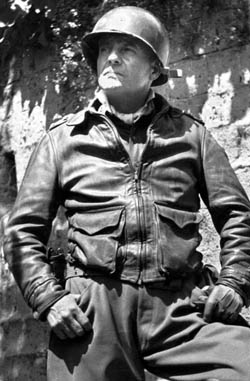
Lucian K. Truscott served in the U.S. Army for 30 years and became one of the outstanding combat commanders of World War II.
By Nathan N. Prefer
In his Maxims of War, Napoleon Bonaparte wrote, “It is exceptional and difficult to find in one man all the qualities necessary for a great general. What is most desirable, and which instantly sets a man apart, is that his intelligence or talent are balanced by his character or courage.” In North Africa, Sicily, Italy, and France, Lucian King Truscott, Jr., proved himself just such a man.
The future general began simply enough when he arrived on January 9, 1895, in Chatfield, Texas. Although the family soon moved to Oklahoma, he would always claim to be a Texan at heart. The grandson of an immigrant from Cornwall, England, he nearly died at a young age when he was playing in his father’s office.
His father, Lucian King Truscott, Sr., was a physician in Chatfield and was busy in another room when his son decided to taste something that looked good in his father’s office. His choice was a poor one, however, and he swallowed some carbolic acid. His father heard his screams and saved his life, but that day he earned one of his trademarks, a raspy, gruff voice that one observer called “a rock-crusher.”
The Truscott family moved to Oklahoma when the land boom began in 1901. Here, young Truscott came into contact with the U.S. Cavalry, an attachment that would last a lifetime.
To help his parents support him and his three sisters, he decided that he and his mother would both attend the Summer Normal School at Norman, Oklahoma. The goal was to acquire a teaching certificate. By age 16, having lied about his age, he was teaching school at Stella, Oklahoma. Later, after another family move, he taught in Onapa, Oklahoma.
Despite his success in achieving a trade, he was restless. This was no doubt what caused him to enlist in the Army Reserves program in which, after two years as a lieutenant, he would become a Regular Army officer.
Lieutenant Truscott’s first assignment was to the 17th Cavalry on the U.S.-Mexican border near Douglas, Arizona. Here he gained on-the-job experience with the vagaries of morning reports, sick reports, duty rosters, and troop administrative requirements.
By the time World War I ended, Lieutenant Truscott was an experienced, if combat-deficient, Army officer. Concerned that he would soon have to return to civilian life, he was relieved to learn that his regiment was being shipped to Hawaii for garrison duties. But before he shipped overseas, Lieutenant Truscott acquired something far more important to his life and career.
General Lucian Truscott proved a capable combat commander in the Mediterranean Theater and rose to command the Allied Fifth Army during World War II.
Sarah Nicholas Randolph was the fourth-generation granddaughter of President Thomas Jefferson and, as such, she had a comfortable life and lofty social standing. Lieutenant Truscott was soon in love, and under the pressure of a move to Hawaii, the two were married on April 5, 1919, in Cochise County, Arizona. With the wedding came a promotion to first lieutenant. In Hawaii he took up polo and became a highly regarded horseman, something he would later have in common with another rising star, George S. Patton.
In a shrinking postwar army, Lieutenant Truscott nevertheless earned a promotion to captain. The interwar years were typical for the Truscotts. After Hawaii came California, then back to Douglas, Arizona. Texas was next, the fourth move in three years. In 1925, Captain Truscott was ordered to attend the Troop Officers’ Course at the Cavalry School in Fort Riley, Kansas where he later served as an instructor.
In 1934, after serving as a troop commander of the 3rd Cavalry Regiment at Fort Myer, Virginia, where he met Majors Dwight D. Eisenhower and George S. Patton and participated in dispersing the “Bonus March” on Washington, he was selected to attend the Command and General Staff School at Fort Leavenworth, Kansas, another prestigious stepping stone to high command. His performance earned him promotion to major, along with an instructorship that lasted until 1940.
In September 1940, the newly promoted Lt. Col. Truscott transferred to the developing armored force. Soon after, Colonel Truscott was off to Fort Lewis, Washington, where he renewed his friendship with Colonel Eisenhower. Together, the two men participated in maneuvers in California. Both would also later participate in the 1941 Louisiana Maneuvers.
After these large-scale maneuvers, Truscott found himself back in Texas, assigned to the 1st Cavalry Division. When word came of the attack on Pearl Harbor, Truscott was promoted to full colonel. While training with his troops Colonel Truscott received an urgent call from General Mark Clark of the War Department who ordered him to report to Washington immediately.
Upon arrival in Washington, Truscott was surprised when General Clark asked if he wanted to become a British commando. These light raiding forces had been developed by the British while they bided their time to rebuild their military strength. General Clark went on to explain that President Franklin D. Roosevelt and British Prime Minister Winston Churchill had agreed to invade Europe in 1943 and, in the meantime, U.S. forces would establish within their organization a group of U.S. commandos.
Truscott was sent to General Eisenhower for details. Eisenhower explained that Army Chief of Staff General George C. Marshall believed that the U.S. Army lacked combat experience throughout its ranks. To achieve this goal, a group of American officers were being sent to England to observe and learn from the experienced British. Colonel Truscott would lead the group that would observe the British Combined Operations Headquarters, the top headquarters for the commandos.
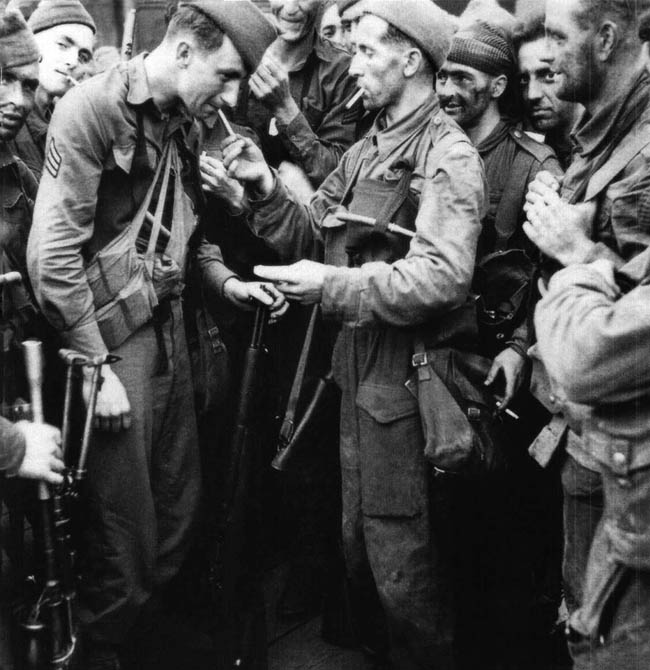
Following the disastrous Dieppe Raid of August 1942, American Rangers and British commandos rest. General Truscott was a major proponent of the Rangers’ formation and was a primary observer during the raid.
After studying every document he could lay his hands on regarding the British situation and listening in on War Department meetings about American plans for the European invasion, Truscott set off for London. As he flew via Canada to England, he received promotion to brigadier general in May 1942. His group began to absorb the organization of the British commando structure from Admiral Lord Louis Mountbatten, and he was invited to sit in on planning conferences for the cross-Channel invasion. He observed commando training and exercises.
The lack of American infantrymen in England at the time and the continuing movement of American units to training bases caused General Truscott to create a unit that could then instruct others rather than pulling men out of existing units. As a result, the 1st Ranger Battalion was created.
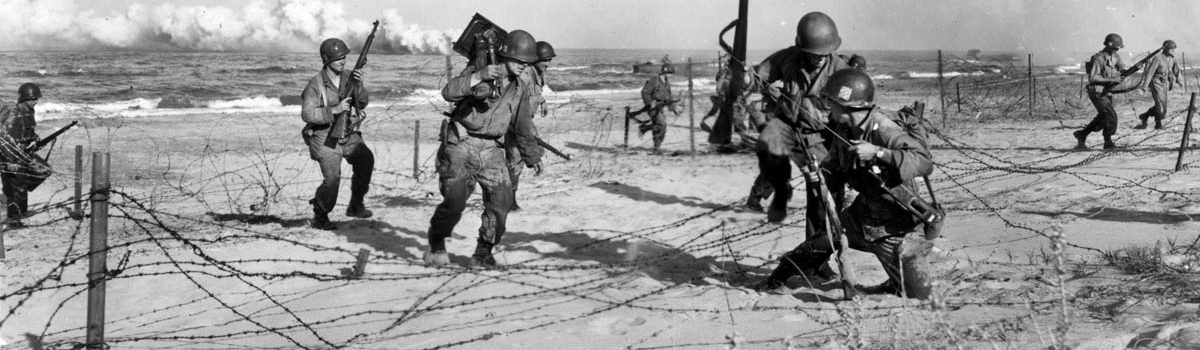
In June, General Truscott was advised of a plan to land a large raiding force at the English Channel port of Dieppe in German-occupied France. Since several commando units would be involved in this operation, Truscott had 50 of his newly trained rangers added to the invasion forces. It would result in the first American combat losses in the European Theater. He observed the bitterly opposed landing from offshore.
General Marshall arrived in London in July, and Truscott was summoned to give a detailed report on every aspect of his stay in London to date. Later, he would attend a meeting with Generals Marshall, Eisenhower, and Clark to go over the same information. Using this data, General Marshall had a tentative plan drawn up for the Allied invasion of Europe. Disagreements between the Allies were resolved, albeit temporarily, by a decision to invade French North Africa in 1942. Truscott and his staff became involved in the planning of the new operation and worked with Eisenhower and Patton on the details.
General Patton was pleased to see his old friend. After asking Truscott what he had been doing in London, Patton said, “Dammit, Lucian, you don’t want to stay on any staff job in London with a war going on. Why don’t you come with me? I will give you a command.” Truscott replied that he was eager to get in on the fighting, but he would need Eisenhower to release him. Patton quickly obtained Truscott’s release and placed him on his staff where he became deeply involved in the planning of Operation Torch, the North African invasion.
With the planning completed, Truscott returned to the United States for his new duties. These involved his command of Sub-Task Force Goalpost, a heavily reinforced regiment from the 9th Infantry Division scheduled to land at Port Lyautey in French Morocco. Organizing an efficient task force took all of Truscott’s time, although he did manage to see Sarah and Lucian III, who was now a West Point cadet.
With a force of 9,079 officers and men, Truscott’s Sub-Task Force Goalpost landed against minimal opposition on November 8, 1942, and seized Port Lyautey and its vital airfields. There were problems, of course. During the approach, the task force lost its direction. H-hour had to be delayed while the assault waves reorganized. Heavy seas slowed matters as well. Some boats missed their assigned beaches. At daybreak, French planes strafed the beaches. Overall, though, the invasion succeeded, and the objectives were soon secured. The French surrendered on November 10. This success earned Truscott promotion to major general.
With the invasion complete, Sub-Task Force Goalpost was disbanded. This left Truscott without a command, so he went to Eisenhower in search of a new one. He was told to “wait around for a few days.” Concerned with the slow progress of American forces toward Tunis, Eisenhower made Truscott his deputy chief of staff to control operations with the British First Army. This was a difficult job, requiring the cooperation of the American, British, and French forces involved. This posting would prove an essential part of the eventual Allied victory in North Africa.
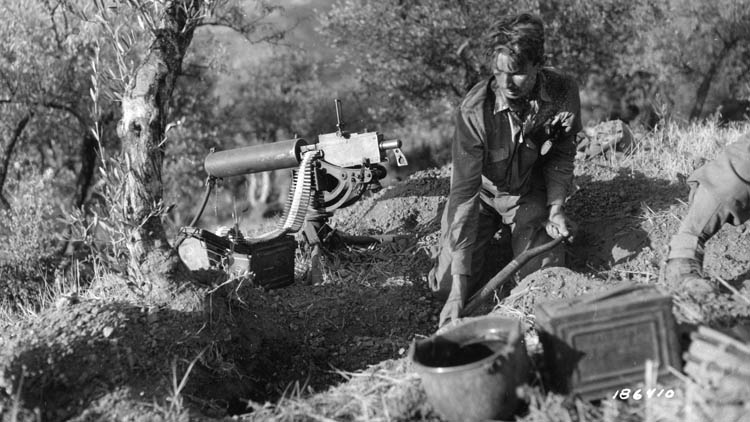
After executing a landing behind German lines at Brolo, Sicily, a soldier of the 3rd Infantry Division digs a foxhole while preparing a machine-gun position.
Once again, Truscott’s outstanding performance earned him a new job, this time commanding the 3rd Infantry Division. The division had an outstanding World War I record and had been stationed at Fort Lewis, Washington, in the interwar years, where both Eisenhower and Truscott had served with it. The division had participated in the North African invasion under Maj. Gen. Jonathan W. Anderson. When the latter was promoted to command of X Corps, Eisenhower gave the division to Truscott in April 1943.
Truscott’s first steps were to improve the training and physical endurance of his new command. As he remembered, “I had long felt that our standards for marching and fighting in the infantry were too low, not up to those of the Roman legions nor countless examples from our own frontier history, not even to those of Stonewall Jackson’s ‘Foot Cavalry’ of Civil War fame,” he wrote. Adopting a tactic of the rangers and commandos, he ordered his men to march at the rate of four miles per hour. Despite initial skepticism, the new rate, soon dubbed “The Truscott Trot,” was achieved by all units of the 3rd Infantry Division and helped make it one of the best combat units of the war.
Alerted for Operation Husky, the coming invasion of Sicily, the division began a new training cycle. The 3rd Infantry Division assaulted Sicily as part of the newly created Seventh Army under Patton. The landings were lightly opposed, and the division quickly moved inland. On the third day of Operation Husky, Truscott was already up front with his leading units, pressing them forward. As he observed one battalion attack an enemy position, his driver advised him that standing in the middle of the road with binoculars was inviting incoming fire. The group retired to a nearby ditch.
Soon Patton came calling. He was frustrated that his army was under orders to pace the advance of the adjoining British Eighth Army under General Bernard L. Montgomery. The two men talked the situation over and felt that the Seventh Army could easily conquer the western half of Sicily with the prize of its largest city, Palermo, if given permission. Together, the two men decided upon a “reconnaissance-in-force” to the west to, as General Truscott wrote, “clear up the situation.” Thus began the “Race for Palermo.”
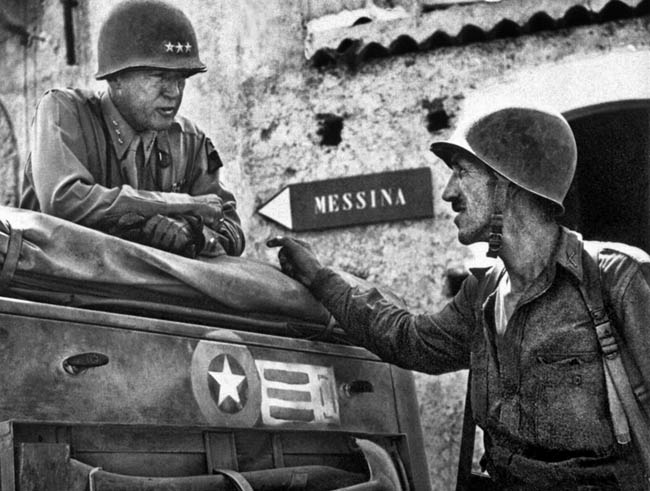
Lieutenant Colonel Lyle Bernard, who led the 2nd Battalion, 30th Infantry Regiment during the amphibious assault at Brolo, confers with General George S. Patton, Jr., commander of the U.S. Seventh Army.
A few days after the capture of Palermo, the 3rd Infantry Division was back fighting the Germans in mountainous eastern Sicily. Progress was slow and costly. This time Patton sent his deputy, Maj. Gen. Geoffrey Keyes, to order Truscott to have one of his battalions conduct an amphibious landing behind the German lines. Truscott agreed with the idea, but insisted that it be within supporting distance of the main division force. This soon became a point of disagreement and resulted in a rather famous episode in Truscott’s career.
The first date for the landing was postponed when German aircraft destroyed one of the landing craft. When the next scheduled date was postponed by Truscott because he felt that the bulk of the division was still too far away to support the isolated battalion, Keyes appeared and demanded the landing proceed. He reported to Patton that Truscott did not want to carry out the landing. An hour later, Patton came screaming into the 3rd Infantry Division command post.
Truscott recalled the scene. “He was screamingly angry as only he could be. ‘Goddammit, Lucian, what’s the matter with you? Are you afraid to fight?’ I bristled right back: ‘General, you know that’s ridiculous and insulting. You have ordered the operation, and it is now loading. If you don’t think I can carry out orders, you can give the division to anyone else you please. But I will tell you one thing, you will not find anyone who can carry out orders which they do not approve as well as I can.’” Truscott’s reply calmed Patton immediately, and the two men settled down to discuss how best to relieve the amphibious force.
Lieutenant Colonel Lyle W. Bernard’s 2nd Battalion, 30th Infantry Regiment, itself at two-thirds strength, was reinforced with three batteries from the 58th Field Artillery Battalion, a platoon of the 10th Combat Engineer Battalion, and a platoon of Company C, 753rd Tank Battalion. As Truscott feared, the battalion took severe punishment in its isolated beachhead, and the division, despite its best efforts, took longer than expected. Seven of the eight artillery pieces were lost as were several tanks and other vehicles. But the battalion survived. By August 16, the division was on the hills overlooking Messina. The battle for Sicily was over.
Initially relieved that his division would not be in the assault phase of the invasion of southern Italy, Truscott was soon ordered by his new commander, Maj. Gen. Mark Clark of the Fifth U.S. Army, to be prepared to land farther north once the Allied advance made progress in that direction. But the strong German defense of the Salerno beachhead soon changed such plans. In less than a week, Truscott was ordered to prepare his division to land at Salerno and join the battle there. While his men sailed to Italy, Truscott went to the beachhead to see things for himself and confer with General Clark. Traveling by PT-boat, he visited the beachhead, saw the strong defenses, and received orders to assign his division to the Fifth Army’s VI Corps once ashore.
During the battles along the German Winter Line at Cassino, Truscott learned of an old plan, Operation Shingle, that had been discarded and now suddenly revived. The VI Corps, along with the 3rd Infantry Division and the British 1st Infantry Division, was to land at the town of Anzio, on the coast behind the Winter Line.
The initial landings in January 1944 went surprisingly well and caught the Germans by surprise. But as always, they recovered quickly and soon had the beachhead surrounded. During the early days of the battle, Truscott was wounded in the leg when an enemy shell exploded nearby. Saved from serious injury by his favorite cavalry breeches and boots, he remained on duty after medical treatment.
The attack to break out of the beachhead failed when unexpected German reinforcements stopped the advance. During this attack, General Truscott suffered a personal blow when three ranger battalions assigned to his division for the attack were overwhelmed by the enemy. The Allies went on the defensive. For several weeks, the VI Corps would struggle to save its beachhead from increasingly heavy enemy assaults.
Truscott was asleep in his headquarters on the evening of February 16, 1944, when he was awakened by Colonel Carleton. He had a message from General Clark that relieved Truscott of command of the 3rd Infantry Division and appointed him deputy commander of the VI Corps.
Truscott arrived at the VI Corps headquarters to find Lucas and his staff concerned over the latest German counterattack, which threatened to push the Allies into the sea. He observed that there seemed to be “a feeling of desperation, of hopelessness” prevalent in the headquarters. “My optimistic assurance that nothing ever looked as bad on the ground as it did on a map at headquarters did little to dispel the pall-like gloom.” Truscott contacted the division commanders, learned the situation, and was satisfied that each had done all he could, and that in fact, the situation was not as bad as first feared.
A few days later, Clark visited the beachhead and invited Truscott to accompany him on a tour of the frontline units. During the ride, Clark intimated to Truscott that in a few days Lucas would be relieved of command of VI Corps, and that Truscott would replace him. Truscott recalled, “I replied that I had no desire whatever to relieve Lucas, who was a personal friend, and I had not wanted to leave the 3rd Infantry Division for this assignment. I had done so without protest because I realized that some of the command, especially on the British side, had lost confidence in Lucas.”
In February 1944, General Lucian Truscott replaced General John P. Lucas in command of the U.S. Army’s VI Corps. Three months later, the corps executed a pivotal role in the breakout from the embattled Anzio beachhead.
Continuing as deputy corps commander, Truscott had some ideas to improve the Allied position. He called in the corps artillery officer, Brig. Gen. Carl A. Baehr, and asked how the artillery was employing its guns. Disturbed by what he heard, he called for the 3rd Infantry Division’s artillery operations officer, Major Walter T. (“Dutch”) Kerwin. After Kerwin explained how the division massed its guns against enemy attacks, Truscott ordered him, accompanied by Baehr for authority, to make similar arrangements for all corps and other divisional artillery units.
On February 22, 1944, Clark returned to the beachhead and met with Truscott, ordering him to assume command of VI Corps the next day. Truscott repeated his earlier arguments against relieving Lucas, but was informed that the decision had been made. Later, after Lucas had been informed of his relief by General Clark, Truscott expressed his regrets as to how things turned out. Lucas expressed no hard feeling against Truscott, and the two men remained friends until Lucas’s death.
As corps commander, Truscott had to deal with problems relating to both the American and the British troops under his command. Further, Clark had established an advanced Fifth Army headquarters at the beachhead, and this brought its own problems in assigning space, priorities, and rights of way.
By May, the VI Corps was heavily reinforced and ready to break out of the Anzio beachhead. The original plan had VI Corps striking east to cut the line of retreat of the German Tenth Army. The opening attacks went well, and General Truscott was ecstatic. After viewing the progress of the attacks, he returned to his command post where Clark’s chief of staff, Brig. Gen. Donald W. Brann, was waiting. The new orders required Truscott to turn the bulk of VI Corps north to capture Rome. Only a token force was to be left to try to cut the German escape route.
Truscott “was dumbfounded. I protested that the conditions were not right. This was no time to drive to the northwest where the enemy was still strong; we should pour our maximum power into the Valmontone Gap to ensure the destruction of the retreating German army.” But the orders remained, and Truscott obeyed, participating in one of the war’s most controversial episodes.
With the capture of Rome, the VI Corps stood down for a brief rest. The months of July and August were spent training and planning a new operation, the invasion of southern France. This time Truscott and his VI Corps were under a revived Seventh Army commanded by Lt. Gen. Alexander (“Sandy”) Patch, a veteran of the Pacific War. Allowed to pick his own combat units for the operation, Truscott chose his favorite 3rd Infantry Division and the equally battleworthy 45th Infantry Division, which had fought under his command at Anzio. The third division was the 36th (“Texas”) Infantry Division, which had led the breakout at Anzio.
Truscott planned and executed Operation Anvil-Dragoon, the invasion of southern France, with little difficulty. The landings were lightly opposed, and the drive inland began quickly. The push toward the Belfort Gap went as planned, and the Germans were too busy withdrawing to make much of a defensive stand. Things continued to go well as the VI Corps entered the Vosges Mountains near the German border. As winter slowed operations, Truscott was visited by Eisenhower, who told him, “Lucian, I am going to assign you to organize the Fifteenth Army. You won’t like it, because this Army is not going to be operational. It will be an administrative and training command, and you won’t get into the fighting.”
General Edward H. (“Ted”) Brooks would take over VI Corps while Truscott returned to the United States for a well-earned rest before returning to command the new army. After two years of fighting in North Africa, Sicily, Italy, and southern France, General Truscott was finally going home.
He thoroughly enjoyed his visit. Besides spending time with his wife, he visited West Point to see his son, Lucian III. As he was preparing to return to Europe, he was suddenly called to Washington. While at the War Department, he learned that the unexpected death of a British senior commander had resulted in a series of promotions and moves that would now affect him. One of the unexpected moves was the promotion of General Clark to command the Fifteenth Army Group in Italy. That left a vacancy in command at Fifth Army. General Marshall asked Truscott, “How do you feel about going back to Italy?” Surprised, Truscott replied, “Sir, I will do the best I can wherever you wish to send me.”
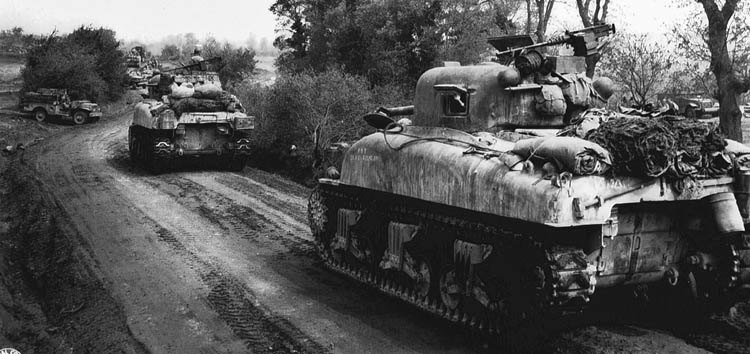
Taking his faithful staff, Truscott assumed command of the Fifth Army in Italy. With 300,000 soldiers under its command, including at various times Britons, South Africans, Polish, New Zealanders, Brazilians, and soldiers of other nationalities, Truscott’s Fifth Army pushed against the new German Winter Line, captured Bologna, broke the back of German resistance at the Gothic Line, and pushed into the Po River Valley, dispersing the German Tenth and Fourteenth Armies. It was a part of the force that accepted the first surrender of a German army group in World War II when Army Group C surrendered to Allied forces in Italy.
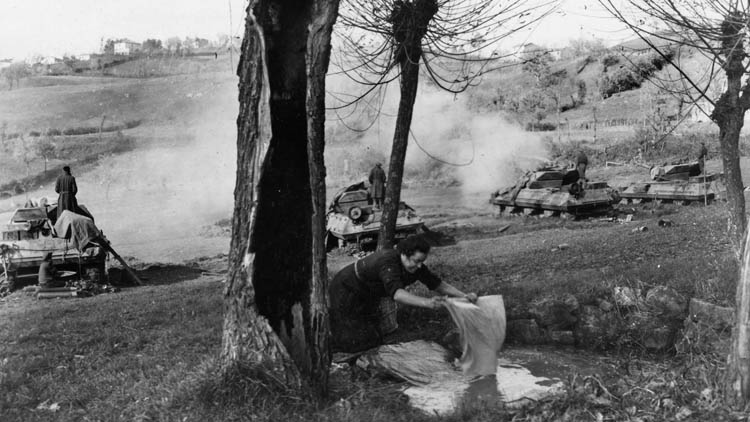
While an Italian woman does her laundry, South African M-10s fire on enemy targets in the city of Bologna. This action took place late in the Italian Campaign as the war in Europe was winding down. Around this time, General Lucian Truscott had returned to Italy to assume command of the Allied Fifth Army.
With the defeat of Germany, Truscott returned to Texas and then volunteered for the war in the Pacific. He was assigned to a group of high-ranking officers who were directed to visit China and prepare to serve there until the defeat of Japan. But even as the group was conducting inspections, Japan surrendered. The war was over. His assignment to command a group of Chinese armies against Japan was moot.
Returning to Italy, Truscott learned that Fifth Army headquarters was to become inoperative. He said goodbye to his faithful staff and decided to visit his friend Patton, then on occupation duty in Germany. Expecting to be sent home to an unknown assignment, Truscott was suddenly caught up in another of Patton’s indiscretions. As he was making the rounds of farewells, Eisenhower’s chief of staff, Maj. Gen. Walter Bedell Smith, caught up with him. Eisenhower wanted to see him immediately. Truscott reported to Eisenhower and learned that he was to replace Patton as commander of the Third Army. For the final time, Truscott protested, but agreed that for the good of the service Patton had to go.
The exchange between two longtime friends went without rancor. When introducing Truscott to the Third Army, Patton said, “A man of General Truscott’s achievements needs no introduction. His deeds speak for themselves.” And so they did.
As the commander of the Third Army on occupation duty, Truscott was faced with new challenges. Tens of thousands of displaced persons needed caring for. He became involved in Cold War politics when, for reasons of their own, some Americans claimed that the Army was abusing or neglecting these unfortunate people. Alerted to the coming storm, Truscott invited newspaper reporters to visit the camps and report accurately on the conditions. Additionally, he was responsible for the trials of Nazi war criminals. He also was responsible for opening a university program for refugees under the auspices of the United Nations. Many who knew him were surprised at his rapid adjustment from combat leader to government administrator.
In early 1946, General Truscott received word that Sarah was seriously ill at Walter Reed Army Hospital. He remained home for 10 days, until he was convinced Sarah was getting well. On the return flight to Germany, he became ill. An electrocardiogram indicated a heart attack, and the doctor ordered several weeks of bed rest. Told that his condition was not improving, Truscott retired on September 30, 1947, after 30 years in the United States Army. He later briefly served as a deputy director of the Central Intelligence Agency. Promoted to the rank of four-star general on the retired list, Lucian King Truscott, Jr., died at the age of 70 on September 12, 1965.
Nathan N. Prefer is the author of several books and articles on World War II. His latest book is titled Leyte 1944, The Soldier’s Battle. He received his Ph.D. in Military History from the City University of New York and is a former Marine Corps Reservist. Dr. Prefer is now retired and resides in Fort Myers, Florida.