
Category: EVIL MF
Yeah I know! There have always been evil and crazy folks out there, Also there has never been in short supply of them especially in my former state of California.
BUT
The “woman / mother” freely admitted in court under oath. ” Yeah I killed them with my bare hands” and these folks are basically cheering her for offing her small children?
Of course if it had been a man or an animal. Hopefully the mob would be forming for the “Necktie” Party outside the cell. Also the guards would go out on an extended coffee break.
BUT because she’s an “oppressed and has some mental problems” woman. Well she gets a get out of jail card.
THE BOTTOM LINE
Anybody out there want to bet that she gets off in the next trial. If the DA has the balls to try again. As I am willing to bet a nickel or two that
A. Will be no trial
B. If there is a trial she will get off and She is then named Mother of the Year by Planned Parenthood.
C. She shows up on the TV Show “The View” as the brave woman who took a hands on position to her problems.
Grumpy
PS It’s a bad day to quit drinking! Also how about this little nugget of info?
Lindsay Clancy supporters donating to her parents’ fundraiser have raised more than $1 million with contributions rolling in almost every minute amid a newly increased target.
On Friday, the fundraiser shared an update after Clancy’s trial collapsed stating that its new goal is $3 million. They are supporting a woman who has confessed to killing her own children. That should shake you to your core.
“Why didn’t the cops shoot her in the leg? Or shoot the knives out of her hand? Why did they have to kill her?”
Whenever a widely publicized police shooting takes place, the internet is instantly alive with armchair experts who want you to know how poorly the involved officers handled it and how easily the situation could have been resolved if only the officers had followed the recommendations the armchair expert has arrived at after watching the video at least twenty times. My old friend, the charming and talented writer Amy Alkon, refers to these people as those who got their Ph.D.s in policing at “Starsky and Hutch University.”
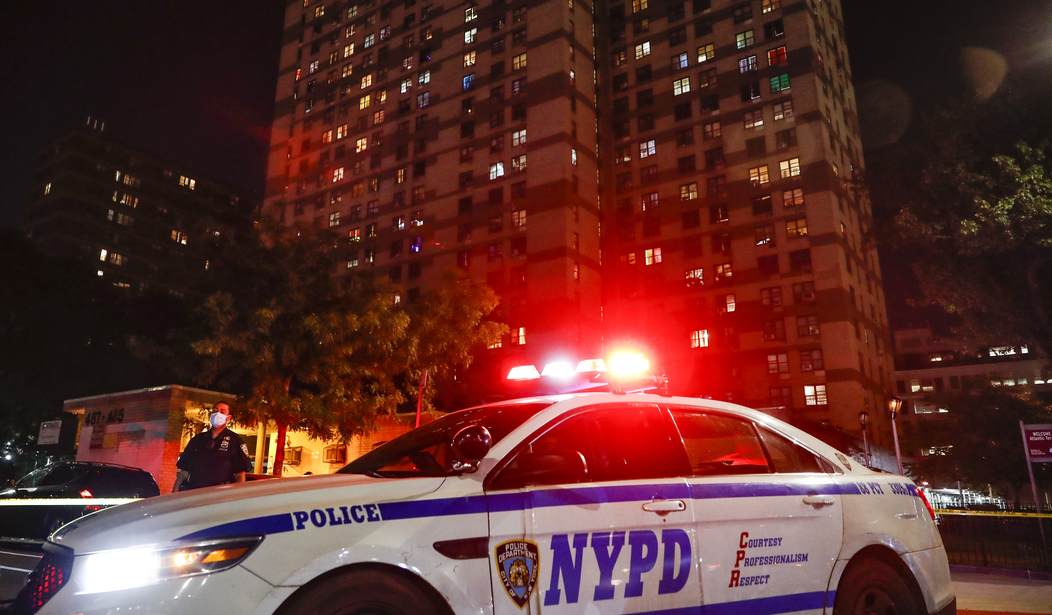
The latest eruption of faux expertise comes in the wake of Monday’s NYPD shooting of Pamela Cisneros, 49, who had just stabbed two people in Times Square, one of them fatally. “[The shooting was] legally justified and the cop probably won’t even get docked vacation days,” wrote one keyboard tactics expert, “but there were multiple officers, they could have disarmed her with a few scratches at worst from those tiny little blades. Why didn’t one circle behind her? They could have kept her contained, talked her down. Legally justified, morally cowardly and reprehensible.”
Where to start with this?
First of all, those “tiny little blades” had already been stained with the blood of two victims, one of whom, a young mother, died as a result.
One might envision a scenario in which the officers disarmed Cisneros while suffering only “a few scratches,” but no police officer is legally or morally obligated to risk death or dismemberment so as to satisfy the utopian visions of people offering their critiques from the safety of their homes.
As set forth by the U.S. Supreme Court in the landmark case of Graham v. Connor (1989), and reaffirmed many times since then, the test of any use of force by the police is whether the officer’s actions were “objectively reasonable” under the circumstances.
The Court further ruled that “[t]he ‘reasonableness’ of a particular use of force must be judged from the perspective of a reasonable officer on the scene, rather than with the 20/20 vision of hindsight,” and that “[t]he calculus of reasonableness must embody allowance for the fact that police officers are often forced to make split-second judgments—in circumstances that are tense, uncertain, and rapidly evolving—about the amount of force that is necessary in a particular situationAlso
Read: Willful Blindness at the Los Angeles Times
So consider those officers on duty Monday in Times Square. Most of them appeared to be assigned to foot posts intended to deter crime and protect the tourist trade on which the area depends. Their days are for the most part spent giving directions to and posing for pictures with tourists and occasionally dealing with petty crimes. Suddenly they are confronted by a woman wielding two knives that only moments earlier she had used to stab two random passersby. Keep in mind that the body armor an officer wears offers little protection against a knife attack, even assuming the assailant stabs the officer in the chest or back and not in the head or neck. A few scratches? Think again.
And unlike a situation involving a barricaded suspect, which allows police ample time to formulate a plan and assemble the necessary personnel and weapons, those officers faced a situation that was the very definition of “tense, uncertain, and rapidly evolving.” Yes, a beanbag shotgun or 40mm launcher would have been valuable in confronting Cisneros, but officers on foot posts have no access to such weapons. (Two officers in a squad car can be seen arriving just before Cisneros is shot, but we don’t know if they had any type of less-lethal munitions.)
As Cisneros began advancing toward the officers, two of them discharged Tasers at her, but with no apparent effect (as is often the case). In short, the officers were out of options. Two of them fired a total of three rounds at Cisneros, killing her.
Yes, an unfortunate outcome, but less for the death of Cisneros than that of the woman she killed. Cisneros was one of the thousands of dangerous mentally ill people allowed to roam the streets of America despite having exhibited behavior that in an earlier time would have resulted in their being confined to some type of facility. If you live or work in a big city you see them every day, and every week there are news stories telling of how one of them has assaulted or killed someone.
So to the Keyboard Kops out there, you’re entitled to your opinions, but the rest of us can be thankful you don’t make the rules.
The “Honorable” Andrew J. May
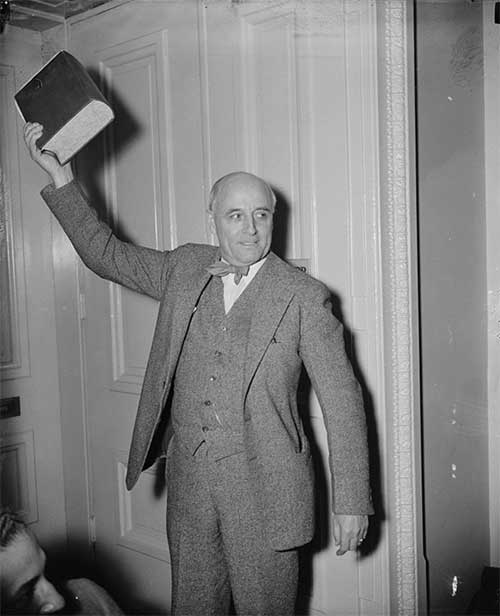
This is Congressman Andrew J. May. He was a card-carrying loser.
This is hands-down the most eventful election cycle of my lifetime. As I sit typing these words, one candidate was shot, and the other left the race because of senility … all in the course of eight days. I like to think of myself as a fairly creative guy, and even I could not make this stuff up.
One might be forgiven for believing the situation hopeless. Regardless of what side of the political fence upon which you might reside, everyone would likely acknowledge that our current crop of politicians comes with a spot of baggage. It’s enough to render a brother demoralized and wistful for the good old days.
Not so fast. While I do long for the purity and patriotism of wartime 1940s America, it seems that electing flaming idiots is a timeless problem. Back in 1943, one particularly ambitious moron killed a whole pile of U.S. submariners.
 Everybody hates politicians. Andrew May was the reason.
The Guy
Andrew J. May was born in 1875 in Kentucky. A natural politician, May served as county attorney for Floyd County, Ky. from 1901 through 1909. Using that experience as a springboard, he landed a judgeship and, eventually, a seat in the U.S. Congress.
Congressman May hooked his wagon to Franklin D. Roosevelt. He was an ardent proponent of the New Deal. May was instrumental in passing the Social Security Act as well as the GI Bill of Rights. He was the primary author of the Peacetime Selective Service Act, which laid the foundation for the sweeping draft that was required to feed the massive American war machine during the early part of WWII. Up until this part in our tale, the Honorable Andrew J. May did indeed seem like an effective servant of the people.
I’ve known a handful of federal lawmakers, a couple of whom I saw in action up close. You cannot do that job for long and stay normal. They’re all disconnected from reality. Eventually, you start believing your own press releases. It is a hop, skip and jump from there over to pure, unfettered narcissism. Andrew May leapt in with both feet.
Never Trust a Politician with Anything Important
In 1943, Congressman May was head of the Military Affairs Committee. In this capacity, he toured American military installations across the Pacific Theater. Along the way, he was privy to a great deal of very sensitive information.
With the entire world at war, details regarding weapons’ capabilities were closely guarded secrets. Then, as now, public servants tended to flaunt both their positions and their access. In this case, the results were fairly catastrophic.
By 1943, the fortunes of American submarines in the Pacific were going swimmingly. Loss rates were low, and attacks on Japanese shipping were taking a vicious toll. One of the reasons for this success was that American subs could dive really, really deep. Back then, our boats could operate at least 400 feet below the surface, markedly deeper than their Japanese counterparts.
The Japanese could not imagine that Yankee submarines would be so much more capable than their own. As a result, when Japanese destroyers attacked U.S. submarines, they would set their depth charges to detonate fairly shallow. American skippers knew if they could just get deep enough, they would be relatively immune to Japanese attack. Then, Congressman May got home from his trip and scheduled a press conference.Congressman May undertook a fact-finding tour of military
installations in the Pacific during the height of WWII. He then
came home and blabbed all the classified details to the press
Stupidity Has a Face
During the course of his press event wherein he outlined all that he was doing to support the war effort, Congressman May casually mentioned that the reason American subs were doing so well was that they were running underneath Japanese depth charges. The meat of his conference made the wire services and spread across the country. Japanese spies took note and sent this information to their handlers back home. It was a simple thing to reset their depth charges to go off a little deeper. The Japanese began bagging U.S. submarines.
Vice Admiral Charles Lockwood, commander of the US submarine fleet in the Pacific, said, “I hear Congressman May said the Jap depth charges are not set deep enough. He would be pleased to know that the Japs set them deeper now.”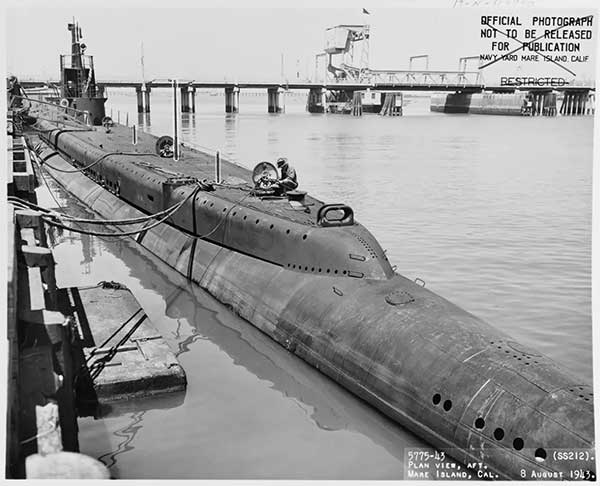
By war’s end, May’s idiocy had directly resulted in the sinking of 10 American submarines and the deaths of some 800 U.S. sailors.American submarines fared well in the Pacific during the early part of WWII. Then Congressman May explained to the Japanese what they needed to do to kill them.
It Gets Even Better
When he wasn’t busy drowning Americans, Congressman May was using his position to make money on the side. May used his influence to obtain war production contracts for his friends Murray and Henry Garsson.
Despite having no experience producing munitions, the Garsson brothers began churning out such stuff as 4.2-inch mortar shells, many of which were found to have had defective fuses. These fuses often resulted in premature detonations that ultimately claimed the lives of a further 38 U.S. soldiers. In exchange for these sweet military contracts, Congressman May accepted a bunch of good old-fashioned bribes.
Once word got out about May’s body count, his constituency threw him out. After losing reelection, May was tried in federal court on charges of bribery and convicted after less than two hours’ worth of deliberation. May served a nine-month prison sentence. The Garssons went to jail as well.
Despite his malfeasance, May remained well-connected. In 1952, President Harry Truman granted him a full pardon. However, voters were apparently smarter than is the case today. Andrew May failed to resurrect his political career and spent the rest of his days working in private practice as a lawyer. He died in 1959 at the age of 83 as the only man in human history personally responsible for the sinking of 10 submarines.

by Lee Williams
Dave Adamiak, whose son Patrick “Tate” Adamiak has 17 more years left to serve in federal prison, is confused, perplexed and nearing his wit’s end.
While he appreciates all the support his son’s case has drawn—there are hundreds of videos and stories chronicled on his “Freedom for Tate” website—Tate remains is prison.
To date, there has been no formal move to secure his release—despite the kind words of more than a few elected officials.
Adamiak’s family sent a pardon request to Attorney General Todd Blanche and U.S. Justice Department Pardon Attorney Edward J. Martin Jr., along with nearly 2,000 signatures of supporters, who all believe Tate should never have been charged with a crime.
Tate’s name remains on President Donald Trump’s pardon list, unlike hundreds of others. In addition to 301 pardon denials, the Pardon Attorney has said that 5,908 clemency applications were also rejected.
His 20-year prison sentence, too, has received scorn, even from ATF Director Robert Cekada.
Cekada believes Adamiak was mistreated and massively over-sentenced.
“On the facts of this case, the sentence Mr. Adamiak received is excessive. Mr. Adamiak had no prior criminal history. He dealt with these weapons as curios. We have no evidence that he intended to use the weapons unlawfully or that he was part of a criminal organization. The extremely high sentencing guidelines likely reflect the paradigmatic cases of individuals possessing destructive devices, such as grenade launchers, and normally involve terrorism or organized criminal activity. No such conduct was present here. For me, unlawful possession of National Firearms Act items sentences approximately in the three-to-five-year range are common,” he told me just over a month ago.
Cekada is not alone. Six Republican lawmakers sent their own letter to Blanche and Martin seeking Adamiak’s release.
Congresswoman Jen Kiggans along with Congressmen Eli Crane, Eric Burlison, Paul A. Gosar, D.D.S., Rob Bresnahan, Jr., and Daniel Webster were very clear as to their intent:
“We, the undersigned Members of Congress, respectfully request that you work with President Donald Trump to give fair consideration to a commutation request for Patrick ‘Tate’ Adamiak. We believe that certain inconsistencies in the regulatory framework applied in his case as well as the broader enforcement environment at the time warrant careful review and consideration for executive clemency,” the lawmakers wrote.
The Representatives were extremely clear about Adamiak’s innocence, stating he had “maintained a well‑documented interest in military history and the lawful collection of historic artifacts, replicas, and training devices.”
“The items of concern in his case were inert collector pieces, nonfunctional replicas, and training aids that were incapable of firing,” the letter states.

For reasons that neither he nor his family understand, Adamiak remains housed in the Western Tidewater Regional Jail in Suffolk, Virginia—a county jail and a dangerous hellhole with none of the amenities of a federal prison.
On the day he first arrived at Tidewater, two guards pepper-sprayed an inmate for little or no reason, rammed his head into a metal door, and then dragged him through the jail until his neck and hand were broken. The jail’s medical staff said the inmate was “unlikely to regain limb control.”
The two guards were later fired and charged with malicious wounding; a Class 3 felony in Virginia involving intentional injury with the intent to maim, disfigure, disable, or kill. They each face up to 20 years in prison and $100,000 in fines.
Attempts to contact Adamiak in this facility were unsuccessful.
Case history
Adamiak, who at the time was an active-duty Navy E-6, was arrested and charged by the ATF during the height of the Biden Administration’s war on guns, gun owners, gun rights and the Second Amendment.
Adamiak had been accepted to attend BUD/S (Basic Underwater Demolition/SEAL training). Had the ATF left him alone, he would likely be leading a Navy SEAL platoon.
After ATF agents kicked down his doors, they found nothing illegal or even suspected of being illegal. As a result, the ATF brought in a specialist, ATF Firearm Enforcement Officer Jeffrey R. Bodell, who discombobulated the actual items that the agents had found—all of which are still sold legally online, most do not even require an ID—and turned them into machineguns and destructive devices.
Adamiak was charged with illegally possessing a machinegun for a toy STEN submachinegun found during the search warrant. He paid $75 for the non-firing Spanish replica—or toy—which was made by Denix and is still sold online. Bodell inserted a real STEN barrel and receiver, neither Bodell nor his assistant could make it fire more than one round at a time. Despite their hard work, the toy STEN would not even accept a real magazine. Still, Bodell officially ruled that the toy was a machinegun.
Adamiak was charged with illegally possessing two destructive devices, two inert RPGs that had holes drilled into their receivers and were stripped of internal parts. ATF’s “expert” added parts from real RPGs until they would fire a single subcaliber 7.62x39mm round. As a result, he classified the RPGs as destructive devices. The inert RPGs are still legally sold today without an FFL or any other paperwork.
Takeaways
Adamiak and his father are very concerned about an upcoming hearing, which is scheduled for next month before Arenda L. Wright Allen, the federal judge who oversaw his trial and sentenced Adamiak to serve 20 years in prison.
They both doubt Judge Allen will give Tate a fair hearing. She has already precluded his attorney from rehashing much of anything from the trial. Adamiak could actually receive even more time behind bars.
Every day seems to be a constant battle, Dave Adamiak said. While Tate receives verbal support, nothing official is ever done.
Dozens of politicians have said Adamiak should never have been charged, yet he remains in prison.
“What about Tate?” Dave Adamiak asked. “It appears he’s been swept under the rug after all the traffic about his case. Everyone seems to know about it, but nothing is ever done. He’s still in prison—for nothing illegal. He broke no law. He did nothing wrong.”

Building up a decent approximation of the gangster Bonnie Parker’s whippit autoloading shotgun
is an inexpensive project within the technical capabilities of most anybody with access to a modest woodshop.
My wife and I met when she was 15 and I was 16. I’ve invested my entire life pursuing that woman. I got a wonderful spouse and three fantastic kids out of the deal.
I like to think I’m a pretty decent guy. I work hard, have a couple of good jobs, don’t have many vices beyond gun collecting and treat others the way I’d like to be treated. From a mother-in-law’s perspective, I’m the perfect suitor. Then why did I have to work so hard to catch a pretty girl of my own?
I posed this question to a female friend one time. I had just seen a very attractive, professionally successful young woman as a patient whose husband was a card-carrying loser. I was perplexed as to what exactly she ever saw in him. My buddy smiled and said, “Sometimes, we just can’t resist the bad boys.” So it was with Bonnie Parker.

The basis for the Remington Model 11 was the original Browning Auto-5 shotgun. This Belgian-made 12-gauge example is a thing of mechanical beauty.
Setting the Stage
Bonnie Elizabeth Parker’s was an undeniably hard life. Born in 1910 in Rowena, Texas, the second of three children, Bonnie seemed cursed with poor judgment. Her father was a bricklayer who died when she was 4. Her mom worked as a seamstress to keep her family from starving. Bonnie came of age living in her grandparents’ home in a place called Cement City in West Dallas.
At age 15, Bonnie married Roy Thornton. Roy was an old-school loser. He was in and out of prison for most of their brief time together, but they never actually divorced. Bonnie was still wearing Roy’s wedding ring when she died. Thornton was shot to death attempting to escape the Huntsville State Prison in 1937.
After her husband was incarcerated, Bonnie began working as a waitress in a Dallas diner. She was said to be cute and flirtatious. One of her regular customers was a local postal worker named Ted Hinton. Hinton was even rumored to have had a crush on the petite blonde at one time. In one of fate’s epic tragedies, Ted Hinton was part of the posse that ultimately killed Bonnie Parker and her sociopath boyfriend, Clyde Barrow.
Clyde Chestnut Barrow grew up poor on a scale unimaginable today. As a boy, Clyde’s family lived underneath the family wagon. It was a significant step up when his father could finally afford a tent. The fifth of seven kids born to an itinerant farmer and his wife, Clyde just seemed to come from the factory broken. He was arrested for the first time at age 17 for stealing a turkey. Bigger stuff followed.
Clyde Barrow was not a terribly imposing man, and he attracted unwanted attention in prison. After being repeatedly sexually assaulted, Barrow beat his tormentor to death with a lead pipe. This was Clyde’s first documented murder. A fellow inmate already serving life claimed responsibility so Barrow could still be eligible for release.
Clyde had little interest in hard labor in the prison fields, so he had another prisoner chop off two of his toes with an ax. His mother unexpectedly secured his release effective six days later. The subsequent limp followed him the rest of his days.
Clyde’s time in prison irrevocably changed him. Where other Depression-era gangsters typically robbed banks to increase their status and fortune, Clyde Barrow sought revenge on the Texas prison system. Clyde and his gang killed at least nine police officers and four innocent civilians along the way.

The Browning Auto-5 (top) can be seen as the forebear of the Remington Model 11 that came later.
The Guns
Bonnie and Clyde robbed 10 banks. However, their preferred targets were small rural stores and funeral homes. Where John Dillinger was partial to the Thompson submachine gun, Clyde Barrow opted for the penetration and overwhelming firepower of the Browning Automatic Rifle.
Clyde procured his BARs from National Guard armories. Back then, the National Guard stockpiled ammunition at these facilities as well. For a guy like Barrow, these armories were like department stores.
At 4’11” and 90 lbs., Bonnie Parker was an undeniably tiny lass. She lacked the substance to manage such artillery as Clyde’s heavy BARs. As a result, Barrow crafted a particular weapon just for her.
The Remington Model 11 autoloading shotgun was a license-produced copy of the Browning Auto-5. With a long recoil design, the barrel on the Model 11 could be pruned back without adversely affecting reliability. Clyde was known to use a 12-gauge version for his smash and grab robberies.
Bonnie had outfitted a pair of Clyde’s trousers with a tear-away pocket on the leg to accommodate the muzzle of this shortened scattergun. Clyde managed the grip through a hole in his jacket pocket. When it was time to get real, he threw back his coat and whipped the muzzle out before anyone could respond.
Bonnie’s customized Model 11 was a 20 gauge. Gangster enthusiasts called these stubby cut-down Model 11 shotguns “whippits.” She supposedly used her personalized scattergun for a most heinous crime.


The Killings
On April 1, 1934, two Texas Highway Patrol motorcycle officers happened upon a car stopped on the side of rural Route 114 near Grapevine, Texas. The cops had no reason to be suspicious. Without warning, a pair of outlaws suddenly opened fire.
Both men collapsed, severely injured. Legend has it a petite young lady subsequently exited the car with a sawed-off shotgun and executed them at contact range.
The Bonnie and Clyde mythos has been flavored through the decades into something romantic and adventurous. The reality, however, was the first couple of crime were actually just a pair of run-of-the-mill psychopaths.
Bonnie Parker apologists insist Clyde actually killed these two patrolmen. Bonnie had previously been badly burned on the leg in an auto accident and was still recovering. However, history has attributed these two merciless executions to the cute little blonde.
You don’t shotgun a pair of cops in America and get away with it. Legendary Texas Ranger Frank Hamer tracked the pair relentlessly before setting an ambush along with several other lawmen on a rural road in Bienville Parish in Louisiana some two months later.
After a storm of rifle, pistol and shotgun fire, Barrow was found to have suffered 17 gunshot wounds. Parker had 26. Tom Hinton, Bonnie’s former customer at the diner, wielded a Colt Monitor BAR and quite possibly killed her.

John Moses Browning was the most prolific gun designer in human history. He viewed the Auto-5 as his most inspired design. Photo: Public Domain

This vintage Remington Model 11 was badly freckled and reblued at some point. This made it cheap and ripe for customization.

Cutting the buttstock back took little talent. Just measure carefully to ensure you leave room for the recoil mechanism nestled inside.

Will used a table saw with a cutoff wheel to shorten the barrel and then fabricated a new front sight bead out of a machine screw. A plumber’s pipe cutter would also produce a nice clean square cut.
Source Material
You can dump a holy fortune on a proper gun collection these days. The era of cheap machine guns and serendipitous barn finds died with the advent of the internet.
The nickel-plated Colt .38 revolver taped to Bonnie’s thigh when she died sold for $99,000 at auction in 2014. However, I built a decent approximation of Bonnie Parker’s whippit for markedly less.
John Moses Browning originally conceived what would ultimately become the Remington Model 11 shotgun in 1898. His subsequent Browning Auto-5 was the world’s first successful autoloading shotgun. Of all his firearms designs, Browning was said to have been most taken with this one.
Browning first tried to sell the Auto-5 to Winchester. Winchester failed to meet Browning’s demands, so he took the design to Remington. The Remington CEO died of a heart attack mid-negotiation, so Browning offered his shotgun to Fabrique Nationale in Belgium.
Remington eventually purchased the rights to build the gun, marketing it from 1906 until 1947. The most significant difference between the Remington and FN versions was the lack of a manual magazine cutoff.
This revolutionary design incorporated a pair of recoil systems. The first managed the recoil of the gun proper and resided within the forearm. The second mechanism telescoped into the stock and returned the bolt into battery after the primary system had cycled the barrel. The mechanism of this second system governed how short the buttstock may be pruned.

There is an undeniable allure to collecting gangster guns like these.

Will is usually the first to admit it’s fun to dress up in a cheap pinstripe suit found at a consignment shop, grease his hair back and play around with a gangster gun on the range.
Whipping Up a Whippit
My gun was a badly pitted reblued beater I found on GunBroker for $230. This wrecked any collector’s value it might have had. I could therefore chop it up without guilt.
Using a cutoff wheel on my table saw, I cut the barrel down to 18″. The details of this process should be included in another article in this magazine. Keep the barrel longer than 18″ and the overall length more than 26, and the gun doesn’t require NFA registration.
I removed the stock and localized the back end of the recoil spring assembly before pruning the stock on the table saw.
I fabricated a new buttplate from workshop scraps, sanded everything to match and touched up the ugly bits with dark wood stain. The result is a decent rendition of Bonnie Parker’s whippit that cost me $230 and a little workshop time.


The love struck criminals met their gory end on a deserted road in Louisiana at the hands of determined lawmen.

Bonnie and Clyde were larger-than-life figures during the era of the motorized bandit. Their pilfered and customized weapons played an out sized role in their notoriety.
Denouement
When Frank Hamer and his men picked through the car after Bonnie and Clyde were killed, they found 100 loaded BAR magazines and another 3,000 rounds of assorted ammunition.
In addition to three BARs, Bonnie’s cut-down 20-gauge Model 11, and her .38 Colt Detective Special revolver, the couple was also packing a short-barreled Winchester Model 1901 lever-action 10 gauge, assorted civilian handguns and seven looted Government Colt M1911 pistols.
Bonnie Parker enjoyed photography as a hobby. Much of how the world perceived Bonnie and Clyde was formed from a series of pictures on an undeveloped roll of film discovered by law enforcement.
These pictures showed the playful criminals snuggling with each other and clowning around with their weapons. These widely distributed images created a mythos.
Bonnie smoked cigarettes, but not cigars. The persona of the cigar-chomping moll wielding a shotgun had no basis in reality, but it captivated the American public.
The combination of illicit sex during a somewhat puritanical period and the couple’s gory demise transformed Bonnie and Clyde into legends of the motorized bandit era. Building up a copy of Bonnie’s unique shotgun let me taste just a little bit of that dark magic myself.