Category: Manly Stuff
A handcuffed enlistee, a burning B-17, and a stubborn ball turret gunner who just wouldn’t quit. Maynard “Snuffy” Smith was flawed, fiery, and absolutely fearless.
From Pedestals to People: Why Flawed Men Still Do Great Things

We expect way too much out of our pastors and our heroes. We put those guys on pedestals that we ourselves could never successfully occupy. To hold such folks to an unreasonable standard simply invites disappointment.
History is littered with examples. The Israelite King David killed a man and stole his wife, yet was described in scripture as a man after God’s own heart.
Martin Luther King defined the Civil Rights movement with his mantra of non-violence, and was likely the sole reason our great nation did not dissolve into anarchy. However, King was also a serial philanderer who plagiarized significant portions of his doctoral dissertation.
Charles Dickens was history’s alpha novelist, yet he was terribly abusive to his wife and children.
Thomas Jefferson penned the Declaration of Independence by day and made babies with his slaves by night.
William Shockley invented the transistor and was the father of the modern computer, yet was an unrepentant racist and a strident proponent of eugenics. For all have sinned and fallen short of the glory of God. That’s in the Book…

I’ll let you in on a little secret: We all suck–Every. Last. One. Of. Us.
If ever I felt otherwise, those flawed assumptions were thoroughly put to rest the moment I became a physician and started trying to fix other people’s many manifest problems. Everybody on Planet Earth is just a hot mess. That includes your sweet grandmother and Mother Theresa.
As a result, have reasonable expectations as regards the people in your life. Don’t be surprised when everybody else in the world struggles with the same stuff you do. Tragically, that’s just part of being human.
Origin Story: From Courtroom to Cockpit in Wartime

Maynard Harrison Smith was born on 19 May 1911 in Caro, Michigan. His Dad was a lawyer, and his Mom taught school. From the very beginning, Maynard was a difficult kid. He sought out trouble at every opportunity. This earned him a billet at Howe Military Academy in lieu of High School.
Like most such broken souls, Maynard Smith found it impossible to stay married. He wed Arlene McCreedy, but that only lasted three years. Two years after that, his Dad died and left Maynard a little money. The young man subsequently quit his job with the US Treasury Department and lived off his inheritance. In 1941, Maynard married Helen Gunsell and fathered a son. They split up about a year later.
Maynard supposedly refused to pay child support and was subsequently dragged before a judge. With war brewing, the magistrate gave him the option of jail or the Army. When the local newspaper ran a patriotic photograph of young men being inducted into the military, Maynard Smith was in the background in handcuffs being escorted by the local sheriff.
Uniform On, Trouble Still: Into the 306th Bomb Group

A great many folks have entered military service and discovered both maturity and depth. My time in uniform played an outsized role in my own success later in life. However, sometimes that stuff just doesn’t take. Maynard Smith was a First Sergeant’s nightmare.
Smith was a short-statured man. After basic training, he volunteered for aerial gunnery school. Prior to 1947, the US Army owned what would eventually become the Air Force under the auspices of the US Army Air Corps.
Smith volunteered for the Air Corps because he knew that would mean faster promotion and more money. After gunnery school, Smith was shipped to Bedfordshire in Southern England to join the 423d Bombardment Squadron of the 306th Bomb Group.
Ball Turret Hell: Cold, Cramped, and Nowhere to Run

Things didn’t get any better once he got to his unit. Maynard soon developed a reputation for being both obnoxious and stubborn. At some point, he earned the nickname “Snuffy” Smith, no doubt a reference to the popular period cartoon strip Barney Google and Snuffy Smith. Because of his modest height, Snuffy Smith drew the duty as a ball turret gunner.
Serving as a bomber crewman was the most dangerous job in the US military during World War 2. Fully one-fifth of all US aircrew perished in the skies above Europe and the Pacific. Of all the jobs on board US heavy bombers, that of the ball turret gunner was statistically the most hazardous.
Inside the Sphere: What a B-17 Ball Turret Demanded

Duty in the ball turret was unlike anything else in the Air Corps. The ball turret was designed to defend B17 and B24 bombers from attack directly underneath the aircraft. The Sperry ball turret was roughly 3.5 feet in diameter and weighed 850 pounds. It was constructed predominantly of transparent Plexiglas and included a pair of M2 .50-caliber belt-fed machine guns. The ball turret gunner sat in the fetal position, wrapped around the two weapons. He controlled the orientation of the turret via a firing yoke.
Duty in the ball turret was, by its nature, terribly isolating. While most of the rest of the crew could interact with each other directly, the ball turret gunner was sealed inside his big plastic sphere.
Because the turret was so small, there was no room for a parachute. Entry and exit were through the back of the contraption. To egress a disabled aircraft, the ball turret gunner had to orient the thing guns-downward such that the hatch faced the interior of the aircraft, unstrap, climb out, locate and attach his parachute, and then find his way to an exit door. That’s a big ask when the plane is shot up, on fire, and plummeting earthward.
Given its direct exposure to the rarefied high-altitude slipstream, the ball turret also got incredibly cold. Gunners were equipped with electrically-heated suits, but this was 1940’s technology. Those suits not infrequently failed. It took a special sort of soldier to thrive in a ball turret in combat.
Snuffy Goes to War: St. Nazaire, the Original Flak City

Six weeks after he arrived at his unit, Snuffy Smith flew his first combat mission. The target was the Nazi U-boat pens at St. Nazaire on the Bay of Biscay in France. The Germans knew this facility to be strategically critical and defended it accordingly with a dense array of flak guns and fighters aplenty. Allied aircrews called St. Nazaire “flak city.”
Aerial navigation in the days before electronic navaids was a sketchy proposition. Somebody made a mistake, and Snuffy’s B17 approached the heavily-defended French city of Brest at around 2,000 feet. Exposed and at low altitude, the big bomber was easy meat for German fighters and anti-aircraft artillery.
When Everything Went Wrong: Fire, Fighters, and a Choice

Smith’s plane was hit hard. A fuel tank ruptured and caught fire. With the fuselage now aflame, three of the plane’s ten crewmen bailed out. Smith clawed his way out of the ball turret and turned his attention to two remaining buddies who were too badly wounded to parachute.
Smith could have jumped himself, but not without abandoning his mates. Instead, he dressed the injured men’s wounds while also manning the bomber’s waist guns against attacking German fighters.
The fire became so hot that it melted through the Fort’s aluminum skin. Smith expended all of the plane’s fire extinguishers and discarded as much flammable material and ammunition as he could through the gaping holes burned in the plane’s fuselage. With nothing left to throw on the fire, Smith dropped his trousers and urinated on it.
Ninety minutes later, Smith’s plane landed at the first available airfield on British soil. The massive bomber broke in half immediately upon touchdown. Ground crews counted 3,500 holes from German bullets and shrapnel.
The three crewmen who bailed out were never heard from again. Snuffy Smith’s selfless actions had saved the lives of the remaining six. Journalist Andy Rooney was present at the air base where Smith’s plane landed and penned a front page story about the obstinate ball gunner’s exploits. Smith was subsequently awarded the Medal of Honor.
Medal of Honor Day… and KP Anyway

Smith was on punitive KP duty the week he was awarded his nation’s highest award for valor for arriving chronically late for command meetings.
His medal was awarded by US Secretary of War Henry Stimson. Snuffy Smith flew four more combat missions after receiving his award, but was ultimately grounded due to battle fatigue. Smith was made a unit clerk but was subsequently reduced in rank to Private because he sucked so bad at it.
Private Smith went home on 2 February 1945. Despite his checkered record, his hometown threw him a rousing parade and greeted him as a hero. Smith left the military three months later.
Whenever interviewed about his time in the military, Smith had nothing but disdain for the experience. His propensity for being difficult followed him everywhere he went. Smith bounced from job to job and suffered perennial legal problems.
The Rest of the Story: A Flawed Man, A Lasting Legacy
Smith married his third wife, Mary Rayner, in 1944. He and Mary met at a USO dance in Bedford, England, and eventually had three sons and a daughter. Snuffy Smith, the deadbeat hero, eventually settled in St. Petersburg, Florida, where he died of heart failure at age 72. He was buried in Arlington National Cemetery.

True heroes seldom look the part. Audie Murphy weighed 112 pounds when he tried and failed to enlist in both the US Marines and the Airborne, yet ended the war as the most highly decorated soldier in American history.
Maynard Smith enlisted in handcuffs and left the military under a cloud. However, he was still nonetheless a hero of the highest order—a flawed man who did some truly amazing things.
Quick Facts: B-17 Ball Turret and Mission Details
| Role | Ball turret gunner, B17 |
|---|---|
| Unit | 423d Bombardment Squadron, 306th Bomb Group |
| Ball Turret Diameter | 3.5 feet |
| Ball Turret Weight | 850 pounds |
| Armament | 2 x M2 .50-caliber machineguns |
| First Combat Target | St. Nazaire U-boat pens |
| Aircraft Damage | 3,500 holes from bullets and shrapnel |
| Lives Saved | Six crewmen |
Pros & Cons — Hard Truths of a Ball Turret Gunner’s War
- Pros: Raw, human story of courage; vivid technical detail on ball turret life; keeps all dates and numbers; powerful, relatable voice.
- Cons: Grim imagery; not a gear review; heavy subject matter for sensitive readers.
Categories
General Matthew B. Ridgway
 IF YOU ASKED A GROUP OF AVERAGE AMERICANS to name the greatest American general of the twentieth century, most would nominate Dwight Eisenhower, the master politician who organized the Allied invasion of Europe, or Douglas MacArthur, a leader in both world wars, or George C. Marshall, the architect of victory in World War II.
John J. Pershing and George S. Patton would also get a fair number of votes. But if you ask professional soldiers that question, a surprising number of them will reply: “Ridgway.”
When they pass this judgment, they are not thinking of the general who excelled as a division commander and an army corps commander in World War II. Many other men distinguished themselves in those roles. The soldiers are remembering the general who rallied a beaten Eighth Army from the brink of defeat in Korea in 1951.
THE SON OF A WEST POINTER who retired as a colonel of the artillery, Matthew Bunker Ridgway graduated from the U.S. Military Academy in 1917. Even there, although his scholastic record was mediocre, he was thinking about how to become a general.
One trait he decided to cultivate was an ability to remember names. By his first-class year, he was able to identify the entire 750-man student body.
To his dismay, instead of being sent into combat in France, Ridgway was ordered to teach Spanish at West Point, an assignment that he was certain meant the death knell of his military career. (As it turned out, it was probably the first of many examples of Ridgway luck; like Eisenhower and Omar Bradley, he escaped the trench mentality that World War I experience inflicted on too many officers.)
Typically, he mastered the language, becoming one of a handful of officers who were fluent in the second tongue of the western hemisphere. He stayed at West Point for six years in the course of which he became acquainted with its controversial young superintendent, Brigadier General Douglas MacArthur, who was trying in vain to stop the academy from still preparing for the War of 1812.
In the 1920s and ’30s, Ridgway’s skills as a writer and linguist brought him more staff assignments than he professed to want—troop leadership was the experience that counted on the promotion ladder.
But Ridgway’s passion for excellence and commitment to the army attracted the attention of a number of people, notably that of a rising star in the generation ahead of him, George Marshall. Ridgway served under Marshall in the 15th Infantry in China in the mid-1930s and was on his general staff in Washington when Pearl Harbor plunged the nation into World War II.
As the army expanded geometrically in the next year, Ridgway acquired two stars and the command of the 82nd Division.
When Marshall decided to turn it into an airborne outfit, Ridgway strapped on a parachute and jumped out of a plane for the first time in his life. Returning to his division, he cheerfully reported there was nothing to the transition to paratrooper.
He quieted a lot of apprehension in the division—although he privately admitted to a few friends that “nothing” was like jumping off the top of a moving freight train onto a hard roadbed.
Dropped into Sicily during the night of July 9, 1943, Ridgway’s paratroopers survived a series of snafus. Navy gunners shot down twenty of their planes as they came over the Mediterranean from North Africa.
In the darkness their confused pilots scattered them all over the island. Nevertheless, they rescued the invasion by preventing the crack Hermann Göring panzer division from attacking the fragile beachhead and throwing the first invaders of Hitler’s Fortress Europe into the sea.
In this campaign, Ridgway displayed many traits that became hallmarks of his generalship. He scored a rear-area command post. Battalion and even company commanders never knew when they would find Ridgway at their elbows, urging them forward, demanding to know why they were doing this and not that.
His close calls with small- and large-caliber enemy fire swiftly acquired legendary proportions. Even Patton, who was not shy about moving forward, ordered Ridgway to stop trying to be the 82nd Division’s point man. Ridgway pretty much ignored the order, calling it “a compliment.”
FROM PATTON, RIDGWAY ACQUIRED ANOTHER COMMAND HABIT: the practice of stopping to tell lower ranks—military policemen, engineers building bridges—they were doing a good job.
He noted the remarkable way this could energize an entire battalion, even a regiment. At the same time, Ridgway displayed a ruthless readiness to relieve any officer who did not meet his extremely high standards of battlefield performance.
Celerity and aggressiveness were what he wanted. If an enemy force appeared on a unit’s front, he wanted an immediate deployment for flank attacks. He did not tolerate commanders who sat down and thought things over for an hour or two.
In the heat of battle, Ridgway also revealed an unrivaled capacity to taunt the enemy. One of his favorite stunts was to stand in the middle of a road under heavy artillery fire and urinate to demonstrate his contempt for German accuracy. Aides and fellow generals repeatedly begged him to abandon this bravado. He ignored them.
Ridgway’s experience as an airborne commander spurred the evolution of another trait that made him almost unique among American soldiers—a readiness to question, even to challenge, the policies of his superiors.
After the snafus of the Sicily drop, Eisenhower and other generals concluded that division-size airborne operations were impractical. Ridgway fought ferociously to maintain the integrity of his division. Winning that argument, he found himself paradoxically menaced by the widespread conclusion that airborne assault could solve problems with miraculous ease.
General Harold Alexander, the British commander of the Allied invasion of Italy, decided Ridgway’s paratroopers were a God-given instrument for disrupting German defense plans.
Alexander ordered the 82nd Airborne to jump north of Rome, seize the city, and hold it while the main army drove from their Salerno beachhead to link up with them. Ridgway was appalled. His men would have to fly without escort—Rome was beyond the range of Allied fighters—risking annihilation before they got to the target.
There were at least six elite German divisions near the city, ready and willing to maul the relatively small 82nd Airborne. An airborne division at this point in the war had only 8,000 men.
Their heaviest gun was a 75 pack howitzer, “a peashooter,” in Ridgway’s words, against tanks. For food, ammunition, fuel, transportation, the Americans were depending on the Italians, who were planning to double-cross the Germans and abandon the war.
Ridgway wangled an interview with General Alexander, who listened to his doubts and airily dismissed them. “Don’t give this another thought, Ridgway. Contact will be made with your division in three days—five at the most,” he said.
RIDGWAY WAS IN A QUANDARY. He could not disobey the direct orders of his superior without destroying his career. He told his division to get ready for the drop, but he refused to abandon his opposition, even though the plan had the enthusiastic backing of Dwight Eisenhower, who was conducting negotiations with the Italians from his headquarters in Algiers. Eisenhower saw the paratroopers as a guarantee that the Americans could protect the Italians from German retribution.
Ridgway discussed the dilemma with Brigadier General Maxwell Taylor, his artillery officer, who volunteered to go to Rome incognito and confer with the Italians on the ground. Ridgway took this offer to General Walter Bedell Smith, Alexander’s American chief of staff, along with more strenuous arguments against the operation.
Smith persuaded Alexander to approve Taylor’s mission. Taylor and an air corps officer traveled to Rome disguised as captured airmen and met Field Marshal Pietro Badoglio, the acting prime minister, who was in charge of the negotiations.
Meanwhile, plans for the drop proceeded at a dozen airfields in Sicily. If Taylor found the Italians unable to keep their promises of support, he was to send a radio message with the code word innocuous in it.
In Rome, Taylor met Badoglio and was appalled by what he heard. The Germans were wise to the Italians’ scheme and had reinforced their divisions around Rome. The 3rd Panzer Grenadier Division alone now had 24,000 men and 200 tanks—enough firepower to annihilate the 82nd Airborne twice over.
A frantic Taylor sent three separate messages over different channels to stop the operation, but word did not reach the 82nd until sixty-two planes loaded with paratroopers were on the runways warming their engines. Ridgway sat down with his chief of staff, shared a bottle of whiskey, and wept with relief.
Looking back years later, Ridgway declared that when the time came for him to meet his maker, his greatest source of pride would not be his accomplishments in battle but his decision to oppose the Rome drop. He also liked to point out that it took seven months for the Allied army to reach the Eternal City.
Repeatedly risking his career in this unprecedented fashion, Ridgway was trying to forge a different kind of battle leadership.
He had studied the appalling slaughters of World War I and was determined that they should never happen again. He believed “the same dignity attaches to the mission given a single soldier as to the duties of the commanding general. . . . All lives are equal on the battlefield, and a dead rifleman is as great a loss in the sight of God as a dead general.”
IN THE NORMANDY INVASION, RIDGWAY HAD NO DIFFICULTY accepting the 82nd’s task. Once more, his men had to surmount a mismanaged airdrop in which paratroopers drowned at sea and in swamps and lost 60 percent of their equipment. Ridgway found himself alone in a pitch-dark field.
He consoled himself with the thought that “at least if no friends were visible, neither were any foes.” Ten miles away, his second-in-command, James Gavin, took charge of most of the fighting for the next twenty-four hours. The paratroopers captured only one of their assigned objectives, but it was a crucial one, the town of Sainte-Mére-Eglise, which blocked German armor from attacking Utah beach. Ridgway was given a third star and command of the XVIII Airborne Corps.
By this time he inspired passionate loyalty in the men around him. Often it came out in odd ways. One day he was visiting a wounded staff officer in an aid station. A paratrooper on the stretcher next to him said, “Still sticking your neck out, huh, General?” Ridgway never forgot the remark.
For him it represented the affection one combat soldier feels for another.
Less well known than his D-Day accomplishments was Ridgway’s role in the Battle of the Bulge. When the Germans smashed into the Ardennes in late December 1944, routing American divisions along a 75-mile front, Ridgway’s airborne corps again became a fire brigade.
The “battling bastards of Bastogne”—the 101st Airborne led by Brigadier General Anthony McAuliffe—got most of the publicity for foiling the German lunge toward Antwerp. But many historians credit Ridgway’s defense of the key road junction of Saint-Vith as a far more significant contribution to the victory.
Ridgway acquired a visual trademark, a hand grenade attached to his paratrooper’s shoulder harness on one side and a first-aid kit, often mistaken for another grenade, on the other strap.
He insisted both were for practical use, not for picturesque effect like Patton’s pearl-handled pistols. In his jeep he also carried an old .30-06 Springfield rifle, loaded with armor-piercing cartridges.
On foot one day deep in the Ardennes forest, trying to find a battalion CP, he was carrying the gun when he heard a “tremendous clatter.” Through the trees he saw what looked like a light tank with a large swastika on its side. He fired five quick shots at the Nazi symbol and crawled away on his belly through the snow. The vehicle turned out to be a self-propelled gun. Inside it, paratroopers who responded to the shots found five dead Germans.
THIS WAS THE MAN—now at the Pentagon, as deputy chief of staff for administration and training—whom the army chose to rescue the situation in Korea when the Chinese swarmed over the Yalu River in early December 1950 and sent EUSAK (the Eighth U.S. Army in Korea) reeling in headlong retreat.
Capping the disarray was the death of the field commander, stumpy Major General Walton (“Johnnie”) Walker, in a jeep accident. Ridgway’s first stop was Tokyo, where he was briefed by the supreme commander, Douglas MacArthur. After listening to a pessimistic summary of the situation, Ridgway asked: “General, if I get over there and find the situation warrants it, do I have your permission to attack?”
“The Eighth Army is yours, Matt,” MacArthur responded. “Do what you think best.”
MacArthur was giving Ridgway freedom—and responsibility—he had never given Walker.
The reason was soon obvious: MacArthur was trying to distance himself from a looming disaster. Morale in the Eighth Army had deteriorated alarmingly while they retreated before the oncoming Chinese. “Bugout fever” was endemic. Within hours of arriving to take command, Ridgway abandoned his hopes for an immediate offensive. His first job was to restore this beaten army’s will to fight.
He went at it with incredible verve and energy. Strapping on his parachute harness with its hand grenade and first-aid kit, he toured the front for three days in an open jeep in bitter cold. “I held to the old-fashioned idea that it helped the spirits of the men to see the Old Man up there in the snow and sleet . . . sharing the same cold miserable existence they had to endure,” he said.
But Ridgway admitted that until a kindhearted major dug up a pile-lined cap and warm gloves for him, he “damn near froze.
Everywhere he went, Ridgway exercised his fabulous memory for faces. By this time he could recognize an estimated 5,000 men at a glance. He dazzled old sergeants and MPs on lonely roads by remembering not only their names but where they had met and what they had said to each other.
But this trick was not enough to revive EUSAK. Everywhere Ridgway found the men unresponsive, reluctant to answer his questions, even to air their gripes.
The defeatism ran from privates through sergeants all the way up to the generals. He was particularly appalled by the atmosphere in the Eighth Army’s main command post in Taegu. There they were talking about withdrawing from Korea, frantically planning how to avoid a Dunkirk.
In his first 48 hours, Ridgway had met with all his American corps and division commanders and all but one of the Republic of Korea division commanders.
He told them—as he had told the staffers in Taegu—that he had no plans whatsoever to evacuate Korea. He reiterated what he had told South Korean president Syngman Rhee in their meeting: “I’ve come to stay. ”
But words could not restore the nerve of many top commanders. Ridgway’s reaction to this defeatism was drastic: He cabled the Pentagon that he wanted to relieve almost every division commander and artillery commander in EUSAK.
He also supplied his bosses with a list of younger fighting generals he wanted to replace the losers. This demand caused political palpitations in Washington, where MacArthur’s growing quarrel with President Harry Truman’s policy was becoming a nightmare.
Ridgway eventually got rid of his losers—but not with one ferocious sweep. The ineffective generals were sent home singly over the next few months as part of a “rotation policy.”
Meanwhile, in a perhaps calculated bit of shock treatment, Ridgway visited I Corps and asked the G-3 to brief him on their battle plans. The officer described plans to withdraw to “successive positions.”
“What are your attack plans?” Ridgway growled. The officer floundered. “Sir—we are withdrawing.” There were no attack plans. “Colonel, you are relieved,” Ridgway said.
That is how the Eighth Army heard the story. Actually, Ridgway ordered the G-3’s commanding officer to relieve him—which probably intensified the shock effect on the corps.
Many officers felt, perhaps with some justice, that Ridgway was brutally unfair to the G-3, who was only carrying out the corps commander’s orders. But Ridgway obviously felt the crisis justified brutality.
As for the lower ranks, Ridgway took immediate steps to satisfy some of their gripes. Warmer clothing was urgently demanded from the States. Stationery to write letters home, and to wounded buddies, was shipped to the front lines—and steak and chicken were added to the menu, with a ferocious insistence that meals be served hot.
Regimental, division, and corps commanders were told in language Ridgway admitted was “often impolite” that it was time to abandon creature comforts and slough off their timidity about getting off the roads and into the hills, where the enemy was holding the high ground. Again and again Ridgway repeated the ancient army slogan “Find them! Fix them! Fight them! Finish them!”
As he shuttled across the front in a light plane or a helicopter, Ridgway studied the terrain beneath him. He was convinced a massive Communist offense was imminent.
He not only wanted to contain it, he wanted to inflict maximum punishment on the enemy. He knew that for the time being he would have to give some ground, but he wanted the price to be high. South of the Han River, he assigned Brigadier General Garrison Davidson, a talented engineer, to take charge of several thousand Korean laborers and create a “deep defensive zone” with a trench system, barbed wire, and artillery positions.
RIDGWAY ALSO PREACHED DEFENSE IN DEPTH to his division and regimental commanders in the lines they were holding north of the Han.
Although they lacked the manpower to halt the Chinese night attacks, he said that by buttoning up tight, unit by unit, at night and counterattacking strongly with armor and infantry teams during the day, the U.N. army could inflict severe punishment on anyone who had come through the gaps in their line.
At the same time, Ridgway ordered that no unit be abandoned if cut off. It was to be “fought for” and rescued unless a “major commander” after “personal appraisal” Ridgway-style—from the front lines—decided its relief would cost as many or more men.
Finally, in this race against the looming Chinese offensive, Ridgway tried to fill another void in the spirit of his men. He knew they were asking each other, “What the hell are we doing here in this God-forgotten spot?” One night he sat down at his desk in his room in Seoul and tried to answer that question.
His first reasons were soldierly: They had orders to fight from the president of the United States, and they were defending the freedom of South Korea.
But the real issues were deeper—”whether the power of Western civilization, as God has permitted it to flower in our own beloved lands, shall defy and defeat Communism; whether the rule of men who shoot their prisoners, enslave their citizens and deride the dignity of man, shall displace the rule of those to whom the individual and his individual rights are sacred.”
In that context, Ridgway wrote, “the sacrifices we have made, and those we shall yet support, are not offered vicariously for others but in our own direct defense.”
On New Year’s Eve, the Chinese and North Koreans attacked with all-out fury. The Eighth Army, Ridgway wrote, “were killing them by the thousands,” but they kept coming.
They smashed huge holes in the center of Ridgway’s battle line, where ROK divisions broke and ran. Ridgway was not surprised—having met their generals, he knew most had little more than a company commander’s experience or expertise. Few armies in existence had taken a worse beating than the ROKs in the first six months of the war.
By January 2 it was evident that the Eighth Army would have to move south of the Han River and abandon Seoul. As he left his headquarters, Ridgway pulled from his musette bag a pair of striped flannel pajama pants “split beyond repair in the upper posterior region.” He tacked them to the wall, the worn-out seat flapping. Above them, in block letters, he left a message:
TO THE COMMANDING GENERAL
CHINESE COMMUNIST FORCES
WITH THE COMPLIMENTS OF
THE COMMANDING GENERAL
EIGHTH ARMY
The story swept through the ranks with predictable effect.
The Eighth Army fell back fifteen miles south of the Han to the defensive line prepared by General Davidson and his Korean laborers.
They retreated, in Ridgway’s words, “as a fighting army, not as a running mob.” They brought with them all their equipment and, most important, their pride. They settled into the elaborate defenses and waited for the Chinese to try again. The battered Communists chose to regroup. Ridgway decided it was time to come off the floor with some Sunday punches of his own.
He set up his advanced command post on a bare bluff at Yoju, about one-third of the way across the peninsula, equidistant from the I Corps and X Corps headquarters.
For the first few weeks, he operated with possibly the smallest staff of any American commander of a major army. Although EUSAK’s force of 350,000 men was in fact the largest field army ever led by an American general, Ridgway’s staff consisted of just six people: two aides, one orderly, a driver for his jeep, and a driver and radio operator for the radio jeep that followed him everywhere.
He lived in two tents, placed end-to-end to create a sort of two-room apartment and heated by a small gasoline stove. Isolated from the social and military formalities of the main CP at Taegu, Ridgway had time for “uninterrupted concentration” on his counteroffensive.
Nearby was a crudely leveled airstrip from which he took off repeatedly to study the terrain in front of him. He combined this personal reconnaissance with intensive study of relief maps provided by the Army Map priceless asset.”
Soon his incredible memory had absorbed the terrain of the entire front, and “every road, every cart track, every hill, every stream, every ridge in that area . . we hoped to control . . . became as familiar to me as . my own backyard,” he later wrote. When he ordered an advance into a sector, he knew exactly what it might involve for his infantrymen.
ON JANUARY 25, WITH A THUNDEROUS ERUPTION OF MASSED ARTILLERY, the Eighth Army went over to the attack in Operation Thunderbolt. The goal was the Han River, which would make the enemy’s grip on Seoul untenable. The offensive was a series of carefully planned advances to designated “phase lines,” beyond each of which no one advanced until every assigned unit reached it.
Again and again Ridgway stressed the importance of having good coordination, inflicting maximum punishment, and keeping major units intact. He called it “good footwork combined with firepower.” The men in the lines called it “the meat grinder.”
To jaundiced observers in the press, the army’s performance was miraculous. Rene Cutforth of the BBC wrote: “Exactly how and why the new army was transformed…from a mob of dispirited boobs…to a tough resilient force is still a matter for speculation and debate.”
A Time correspondent came closest to explaining it: “The boys aren’t up there fighting for democracy now. They’re fighting because the platoon leader is leading them and the platoon leader is fighting because of the command, and so on right up to the top.”
By February 10 the Eighth Army had its left flank anchored on the Han and had captured Inchon and Seoul’s Kimpo Airfield.
After fighting off a ferocious Chinese counterattack on Lincoln’s birthday, Ridgway launched offensives from his center and right flank with equal success. In one of these, paratroopers were used to trap a large number of Chinese between them and an armored column.
Ridgway was sorely tempted to jump with them, but he realized it would be “a damn fool thing” for an army commander to do. Instead, he landed on a road in his light plane about a half hour after the paratroopers hit the ground.
M-1s were barking all around him. At one point a dead Chinese came rolling down a hill and dangled from a bank above Ridgway’s head.
His pilot, an ex-infantryman, grabbed a carbine out of the plane and joined the shooting. Ridgway stood in the road, feeling “that lifting of the spirits, that sudden quickening of the breath and the sudden sharpening of all the senses that comes to a man in the midst of battle.” None of his exploits in Korea better demonstrates why he was able to communicate a fierce appetite for combat to his men.
Still another incident dramatized Ridgway’s instinctive sympathy for the lowliest private in his ranks.
In early March he was on a hillside watching a battalion of the 1st Marine Division moving up for an attack. In the line was a gaunt boy with a heavy radio on his back. He kept stumbling over an untied shoelace. “Hey, how about one of you sonsabitches tying my shoe?” he howled to his buddies. Ridgway slid down the snowy bank, landed at his feet, and tied the laces.
Fifty-four days after Ridgway took command, the Eighth Army had driven the Communists across the 38th parallel, the line dividing North and South Korea, inflicting enormous losses with every mile they advanced.
The reeling enemy began surrendering by the hundreds. Seoul was recaptured on March 14, a symbolic defeat of tremendous proportions to the Communists’ political ambitions.
Ridgway was now “supremely confident” his men could take “any objective” assigned to them. “The American flag never flew over a prouder, tougher, more spirited and more competent fighting force than was the Eighth Army as it drove north beyond the parallel,” he declared. But he agreed with President Truman’s decision to stop at the parallel and seek a negotiated truce.
In Tokyo his immediate superior General Douglas MacArthur, did not agree and let his opinion resound through the media.
On April 11 Ridgway was at the front in a snowstorm supervising final plans for an attack on the Chinese stronghold of Chörwön, when a correspondent said, “Well, General, I guess congratulations are in order.”
That was how he learned that Truman had fired MacArthur and given Ridgway his job as supreme commander in the Far East and as America’s proconsul in Japan.
Ridgway was replaced as Eighth Army commander by Lieutenant General James Van Fleet, who continued Ridgway’s policy of using coordinated firepower, rolling with Communist counterpunches, inflicting maximum casualties.
Peace talks and occasionally bitter fighting dragged on for another twenty-eight months, but there was never any doubt that EUSAK was in Korea to stay. Ridgway and Van Fleet built the ROK Army into a formidable force during these months. They also successfully integrated black and white troops in EUSAK.
Later, Ridgway tried to combine his “profound respect” for Douglas MacArthur and his conviction that President Truman had done the right thing in relieving him.
Ridgway maintained that MacArthur had every right to make his views heard in Washington, but not to disagree publicly with the president’s decision to fight a limited war in Korea. Ridgway, with his deep concern for the individual soldier, accepted the concept of limited war fought for sharply defined goals as the only sensible doctrine in the nuclear age.
After leaving the Far East, Ridgway would go on to become head of NATO in Europe and chairrnan of the Joint Chiefs of Staff under President Eisenhower. Ironically, at the end of his career he would find himself in a MacArthuresque position.
Secretary of Defense Charles E. (“Engine Charlie”) Wilson had persuaded Ike to slash the defense budget—with 76 percent of the cuts falling on the army. Wilson latched on to Secretary of State John Foster Dulles’s foreign policy, which relied on the threat of massive nuclear retaliation to intimidate the Communists. Wilson thought he could get more bang for the buck by giving almost half the funds in the budget to the air force.
Ridgway refused to go along with Eisenhower. In testimony before Congress, he strongly disagreed with the administration’s policy. He insisted it was important that the United States be able to fight limited wars, without nuclear weapons.
He said massive retaliation was “repugnant to the ideals of a Christian nation” and incompatible with the basic aim of the United States, “a just and durable peace.”
EISENHOWER WAS INFURIATED, BUT RIDGWAY STOOD HIS GROUND—and in fact proceeded to take yet another stand that angered top members of the administration.
In early 1954 the French army was on the brink of collapse in Vietnam. Secretary of State Dulles and a number of other influential voices wanted the United States to intervene to rescue the situation. Alarmed, Ridgway sent a team of army experts to Vietnam to assess the situation. They came back with grim information.
Vietnam, they reported, was not a promising place to fight a modern war. It had almost nothing a modern army needed—good highways, port facilities, airfields, railways. Everything would have to be built from scratch.
Moreover, the native population was politically unreliable, and the jungle terrain was made to order for guerrilla warfare. The experts estimated that to win the war the United States would have to commit more troops than it had sent to Korea.
Ridgway sent the report up through channels to Eisenhower. A few days later he was told to have one of his staff give a logistic briefing on Vietnam to the president. Ridgway gave it himself. Eisenhower listened impassively and asked only a few questions, but it was clear to Ridgway that he understood the full implications. With minimum fanfare, the president ruled against intervention.
For reasons that still puzzle historians, no one in the Kennedy administration ever displayed the slightest interest in the Ridgway report—not even Kennedy’s secretary of state, Dean Rusk, who as assistant secretary of state for Far Eastern affairs in 1950–51 knew and admired what Ridgway had achieved in Korea.
As Ridgway left office, Rusk wrote him a fulsome letter telling him he had “saved your country from the humiliation of defeat through the loss of morale in high places.”
The report on Vietnam was almost the last act of Ridgway’s long career as an American soldier. Determined to find a team player, Eisenhower did not invite him to spend a second term as chief of staff, as was customary.
Nor was he offered another job elsewhere. Although Ridgway officially retired, his departure was clearly understood by Washington insiders as that rarest of things in the U.S. Army, a resignation in protest.
After leaving the army in 1955, Ridgway became chairman and chief executive officer of the Mellon Institute of Industrial Research, in Pittsburgh. He retired from this post in 1960 and has continued to live in a suburb of Pittsburgh. At this writing he is 97. [Editor’s note: Ridgway died at age 98 on July 26, 1993.]
When Ridgway was leaving Japan to become commander of NATO, he told James Michener, “I cannot subscribe to the idea that civilian thought per se is any more valid than military thought.”
Without abandoning his traditional obedience to his civilian superiors, Ridgway insisted on his right to be a thinking man’s soldier—the same soldier who talked back to his military superiors when he thought their plans were likely to lead to the “needless sacrifice of priceless lives.”
David Halberstam is among those who believe that Ridgway’s refusal to go along with intervention in Vietnam was his finest hour.
Halberstam called him the “one hero” of his book on our involvement in Vietnam, The Best and the Brightest. But for the student of military history, the Ridgway of Korea towers higher.
His achievement proved the doctrine of limited war can work, provided those fighting it are led by someone who knows how to ignite their pride and confidence as soldiers.
Ridgway’s revival of the Eighth Army is the stuff of legends, a paradigm of American generalship. Omar Bradley put it best: “His brilliant, driving uncompromising leadership [turned] the tide of battle like no other general’s in our military history.” Not long after Ridgway’s arrival in Korea, one of the lower ranks summed up EUSAK’s new spirit with a wisecrack: “From now on there’s a right way, a wrong way, and a Ridgway.” MHQ
THOMAS FLEMING is a historian, novelist, and contributing editor of MHQ. He is at present working on a novel about the German resistance to Hitler.


|
Royce Williams
|
|
|---|---|

Williams in 1973
|
|
| Birth name | Elmer Royce Williams |
| Nickname | Royce |
| Born | 4 April 1925
Wilmot, South Dakota, U.S.
|
| Branch |  United States Navy United States Navy |
| Service years | 1943–1980 |
| Rank | Captain |
| Commands | USS Eldorado, CVW-11, VF-33[1] |
| Known for | Downing four Soviet MiG-15s in one engagement during the Korean War |
| Conflicts | World War II Korean War Vietnam War |
| Awards | |
| Alma mater | University of Minnesota |
Elmer Royce Williams[2] (born 4 April 1925) is a retired United States Navy (USN) naval aviator. He is known for his solo dogfight with seven Soviet pilots during the Korean War in 1952, which military experts have called “one of the greatest feats in aviation history”.[3] Originally awarded the Silver Star in 1953 for his conduct during the dogfight, in 2023 he was given an upgrade to the Navy Cross, the Navy’s second highest decoration. In 2026, Williams was awarded the Medal of Honor.[4] Williams is the last living Medal of Honor recipient of the Korean War.[note 1]
Early life and military career
Royce Williams was born on 4 April 1925, and grew up in Wilmot, South Dakota and Clinton, Minnesota.[5] He and his brother aspired to become pilots; both enlisted during World War II, although Royce Williams’ flight training was deferred while he attended college in Minnesota. He qualified as a naval aviator at Pensacola in August 1945.[6]
He learned to fly the F9F-5 Panther jet and was assigned to active duty in the Korean War, during which he flew 70 missions.[3]

In 1952, then-Lieutenant Williams was serving with VF-781 aboard the USS Oriskany as part of Task Force 77. On 18 November 1952, on his second mission of the day, while on combat air patrol near Hoeryong, North Korea, his group of four pilots spotted seven MiG-15s overhead. Two of the other three pilots had to return to the carrier and the MiGs began attacking Williams, putting him into a 35-minute dogfight with seven MiG-15s.[7] It is believed to be the longest dogfight in U.S. Navy history.[3] Commanders on his carrier ordered him away, but Williams had to tell them that he was already fighting for his life.[8] He shot down four of the MiGs and likely hit two others.[9] By the end of the 35-minute period, only one of the MiGs was still in the air with him, and he managed to escape back to his carrier, out of ammunition and having lost his hydraulics. He was uninjured, but 263 holes were counted in his Panther jet. Some accounts state that he never saw the plane again as it was pushed into the sea.[7]
The story of his battle with the Soviet MiGs led to Williams being debriefed at the time by admirals, the Secretary of Defense, and a few weeks later by newly inaugurated President Dwight D. Eisenhower.[8] These authorities decided to cover up the specifics of the battle, because the Soviet Union was not officially a combatant in the Korean War and it was feared that publicity about the air battle would draw the Soviets further into the conflict. The dogfight was scrubbed from U.S. Navy and National Security Agency records, and Williams was sworn to secrecy about the incident—so much so that he never told anyone about it, not even his wife nor his pilot brother, until the Korean War records were declassified in 2002.[3] The record of the incident in Navy records said only that he shot down one enemy (not listed as “Soviet”)[8] plane and damaged another, for which he was awarded the Silver Star in 1953.[10]
However, the dogfight was recorded in Soviet archives which were released after the fall of the Soviet Union in the 1990s. The Soviet records say that only one of four MiGs returned to base. A 2014 Russian book, Red Devils over the Yalu: A Chronicle of Soviet Aerial Operations in the Korean War 1950–53, describes the battle and mentions Williams. The four MiGs were flown by Soviet Naval Aviation pilots, with Captain Beliakov and Lieutenants Pakhomkin and Vandaev being shot down, and Lieutenant Pushkarev returning to base.[11]
In his book Holding the Line about Task Force 77, Thomas McKelvey Cleaver described the fight, saying “On November 18, 1952, Royce Williams became the top-scoring carrier-based naval aviator and the top-scoring naval aviator in a Navy jet of the ‘forgotten war’.” He added, “In the fight of his life, Royce Williams had accomplished what no other American fighter pilot would ever accomplish: shoot down four MiG-15s in one fight.”[6]
Between 1965 and 1967, he flew 110 missions in A-4 Skyhawks and F-4 Phantoms from the aircraft carrier USS Kitty Hawk during the Vietnam War.[12] Williams was the commanding officer of the command ship USS Eldorado between September 1969 and January 1971.[2] He retired from the Navy as a captain in 1980. In retirement, he lives in Escondido, California.[9]
A 50+ year secret
Williams maintained his secrecy about his aerial feat for decades. After the information was declassified, he shared his story with close friends and spoke about it at small gatherings. His story first received national attention when the American Legion Magazine published a cover story in November 2017.
In the story, Williams detailed the aerial battle, his vow of secrecy and his other military service. Williams, a longtime member of The American Legion, also received support from the national organization. In August 2017, the Legion’s National Executive Committee approved Resolution 70, which calls for the Legion to petition Congress and the Department of Defense to award the Medal of Honor to recognize Williams.
Medal of Honor campaign
.jpg)
In 2014, retired Rear Admiral Doniphan Shelton became aware of Williams’ feat, and he began an unsuccessful years-long campaign for the Navy or Department of Defense to recommend him for the Medal of Honor for his exploit. Shelton said that Williams’ heroism was “unmatched either in the Korean War, the Vietnam War, or since then”.[13] On 14 July 2022, a bipartisan group of five congressmen persuaded the House of Representatives to approve an amendment to the Defense Authorization Act which would waive the statute of limitations for a potential Medal of Honor for Williams. The amendment and bill were approved for the House version of the bill, which were then forwarded to the United States Senate, which removed the provision in conference.[14][9][15]
In December 2022 Williams was awarded the Navy Cross as an upgrade of the Silver Star the Navy awarded him in 1953.[16] The award was approved by U.S. Secretary of the Navy Carlos Del Toro, who said, “Having reviewed the findings of now numerous investigations related to the case of Capt. Royce Williams, I have determined this case to be special and extraordinary. His actions clearly distinguished himself during a high-risk mission and deserve proper recognition.”[17]
.jpg)
On 4 February 2026, Williams’ congressman Darrell Issa announced confirmation from President Donald Trump that Williams would be receiving the Medal of Honor.[18] The award was received at the 2026 State of the Union Address on 24 February 2026, presented by First Lady Melania Trump.[4] Following the awarding, Williams is the last living Korean War Medal of Honor recipient.[19]
Medal of Honor Citation

For conspicuous gallantry and intrepidity at the risk of his life above and beyond the call of duty on 18 November 1952 while leading a division of three jet fighters attached to Fighter Squadron SEVEN HUNDRED EIGHTY-ONE (VF-781) and embarked on the USS ORISKANY. While flying a combat patrol mission over the northeastern coastal waters of enemy-held North Korea, Lieutenant Williams demonstrated extraordinary heroism by intercepting a superior force of attacking enemy MiG-15 fighters in order to protect the ships of Task Force 77. After thwarting the enemy’s initial attack, he maneuvered his aircraft to make two firing passes on one MiG, which then spiraled into the sea. He inflicted heavy damage to a second MiG-15, which started smoking badly and retired from the fight. When his own aircraft was severely damaged by a direct hit from one of the remaining enemy MiG-15s, Lieutenant WIlliams evaded further enemy attack while continuing to direct the dogfight. He eventually found cover in a cloud bank, broke off the engagement, and miraculously landed his nearly uncontrollable aircraft on the USS ORISKANY. His exceptional airmanship, coupled with his complete disregard for his own personal safety, resulted in the destruction of three enemy MiG-15s and severe damage to a fourth, and undoubtedly saved the lives of hundreds of Task Force 77 sailors. By his undaunted courage, bold initiative, and total devotion to duty, Lieutenant Williams reflected great credit upon himself and upheld the highest traditions of the United States Naval Service.[20]
Awards and decorations
His medals include the Medal of Honor, the Legion of Merit with Combat “V” and two Distinguished Flying Crosses.[5][12]
 |
||
 |
||

|

|
 |
|
|

|
|

|
 |
 |
 |
 |
 |
|
|
|
 |
|
|
.svg) |
 |
 |
 |
 |


| Badge | Naval Aviator Badge | ||
|---|---|---|---|
| 1st row | Medal of Honor | ||
| 2nd row | Legion of Meritwith “V” Device | Distinguished Flying Crosswith 5⁄16-inch star | Bronze Star Medal |
| 3rd row | Meritorious Service Medalwith 5⁄16-inch star | Air Medalwith 10 5⁄16-inch stars | Navy Commendation Medalwith “V” Device |
| 4th row | Navy Unit Commendationwith 1 Service star | Navy Meritorious Unit Commendation | China Service Medal |
| 5th row | American Campaign Medal | World War II Victory Medal | Navy Occupation Service Medalwith ‘Asia’ clasp |
| 6th row | National Defense Service Medalwith 1 Service star | Korean Service Medalwith 3 Campaign stars | Armed Forces Expeditionary Medal |
| 7th row | Vietnam Service Medalwith 4 Campaign stars | Korean Presidential Unit Citation | RVN Gallantry Cross Unit Citationwith Palm |
| 8th row | Korean Presidential Unit Citation | United Nations Service Medal Korea | Korean War Service MedalRetroactively awarded, 2003 |
Foreign awards
 |
| Order of Military MeritTaeguk Cordon Medal |
In popular culture
In 2020, a 20-minute documentary, Actions Speak Louder Than Medals – the Royce Williams Story, directed by John Mollison, was screened at the GI Film Festival, San Diego.[21] Captain Royce Williams dictated his life story to author W. Craig Reed for publishing in the book The 7 Secrets of Neuron Leadership, the only book in print with Royce’s full biographical life story. Reed lives near Royce and spent many nights on his balcony listening to his incredible “sea stories.” Royce notes that President Eisenhower convinced him to switch from bourbon to scotch, however, Reed introduced Royce to Monkey Shoulder scotch, which is now the only drink he prefers.
|
Eric Slover
|
|
|---|---|
.jpg)
CW5 Eric Slover receiving the Medal of Honor
|
|
| Allegiance | United States |
| Branch | United States Army |
| Rank | Chief Warrant Officer 5 |
| Unit | 160th Special Operations Aviation Regiment (Airborne) |
| Conflicts | War in Afghanistan 2026 United States intervention in Venezuela |
| Awards | Medal of Honor Distinguished Flying Cross (2) with one valor device Bronze Star (3) Purple Heart Meritorious Service Medal (4) Air Medal (4) |
Eric Slover is a United States Army Chief Warrant Officer 5 (CW5) who received the Medal of Honor for his actions during Operation Absolute Resolve.[1] During the operation, Slover was a MH-47 Chinook pilot in the 160th Special Operations Aviation Regiment (Airborne), colloquially known as the Night Stalkers.[2][3]
Military career
Slover enlisted in the Army in 2005. After completing basic training he attended Warrant Officer Candidate School and flight school, becoming a Chinook pilot.[4]
Afghanistan
While assisting in a medical evacuation in the Badghis Province in November of 2009 with the 82nd Airborne Division, a helicopter Slover was piloting was pierced by a rocket-propelled grenade. The munition failed to explode and remained in the helicopter for the duration of the flight. After landing, Slover was the first off the Chinook to get explosives experts and help for the wounded. This medical evacuation mission was described in 2009 as one of the “biggest of the Afghan War”.[5][6]
Operation Absolute Resolve
During the American raid that captured Venezuelan President Nicolás Maduro, Slover was the flight lead in the cockpit of the first helicopter, a MH-47 Chinook. The helicopter came under severe machine-gun fire and Slover was hit four times in his leg and hip. Maintaining control of the aircraft despite his wounds, Slover safely landed the helicopter, allowing the operation to continue. Slover was awarded the Medal of Honor by US President Donald Trump at the 2026 State of the Union Address.[7] Slover was one of two men to receive the Medal of Honor during the address, alongside the 100-year-old US Navy Captain E. Royce Williams, a veteran of the Korean War.[8] This was the first time the Medal of Honor had been awarded at the State of the Union Address.[9]
Medal of Honor citation
Chief Warrant Officer Five Eric A. Slover distinguished himself by conspicuous gallantry and intrepidity, above and beyond the call of duty, on January 3, 2026, during a mission in Venezuela, in support of Operation Absolute Resolve. Chief Warrant Officer Five Slover piloted his MH-47 as the lead aircraft of the operation, tasked with executing a highly complex infiltration through hostile Integrated Air Defense Systems to safely deliver military forces. During ingress, Chief Warrant Officer Five Slover skillfully led the helicopter force through a dense jungle valley in a mountainous region, navigating marginal weather conditions, numerous topographical hazards, and near insurmountable surface to air threats. Upon touching down at the designated landing zone, Chief Warrant Officer Five Slover’s aircraft was immediately engaged by multiple machine gun positions at close range. The hostile fire resulted in 15 armor-piercing rounds entering his cockpit, with four rounds striking his leg. Despite the intense and effective enemy fire, and at great personal risk, Chief Warrant Officer Five Slover maintained his situational awareness and aircraft’s position in the line of fire to ensure the safe infiltration of the military forces. After the force disembarked, and despite suffering significant life-threatening injuries, Chief Warrant Officer Five Slover identified hostile heavy machine gun positions that were engaging his aircraft and targeting the ground forces. He maneuvered his aircraft to enable his door gunner to deliver effective fire, successfully neutralizing the threats. Chief Warrant Officer Five Slover’s heroic actions undoubtedly saved countless American lives and ensured the complete and overwhelming success of the mission. His gallantry under fire and extraordinary valor are in keeping with the highest traditions of military service and reflect great credit upon himself and the United States Army.[10]
Personal life
Slover is a graduate of the College of Graduate and Continuing Studies at Norwich University located in Northfield, Vermont.[11] His wife, Amy, blessed his dog tags with holy water before the mission that resulted in his Medal of Honor-winning actions.[12]
Awards


.svg)
.jpg)


.svg)


References
Categories
The last great act of defiance

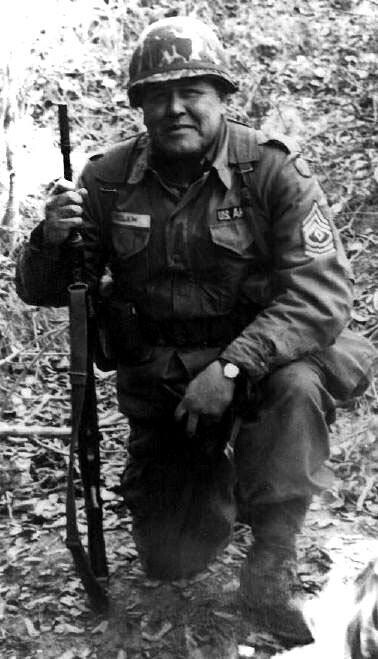
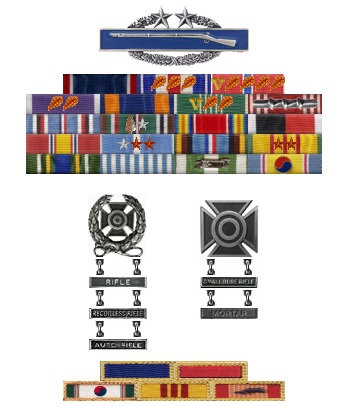
Remembering Pascal Cleatus Poolaw, Sr., the most decorated Native American soldier in U.S. history – 4 Silver Stars, 5 Bronze Stars 3 Purple Hearts. He earned a total of 42 medals and citations.
Born on January 29, 1922, in Apache, Oklahoma, Poolaw, a full-blooded Kiowa, served with the United States Army in World War II, the Korean War, and the Vietnam War.
Poolaw, his father and two brothers joined the Armed forces in 1942 during World War II.
He earned his first Purple Heart when he was wounded in September 1944. While serving with the 8th Infantry Regiment’s M Company near Recogne, Belgium, Poolaw’s unit was engaging fire with the Germans.
He pushed his unit forward under heavy fire and hurled hand grenades at enemy machine guns, causing numerous enemy casualties and as a result of his heroic actions, many of his comrades lives were saved and the company was able to continue the attack and capture strongly defended enemy positions.
Poolaw’s military career did not end in Belgium with fighting Germans. During the Korean War, Poolaw saw combat and was wounded again and awarded the Distinguished Service Cross, a second Purple Heart, and two more Silver Stars.
He returned to the U.S. in 1952 and retired from the Army ten years later. This is not where his military career ends.
During the Vietnam War, all four of the Poolaw’s sons were in the military. In February 1967, his son, Pascal Jr., was injured by a landmine in Vietnam.
This injury resulted in amputation of his right leg below the knee. Poolaw’s youngest son, Lindy, was also drafted. Afraid of what could happen to his sons as the war progressed, Poolaw rejoined the Army at the age of 45. Giving up his rank as a 2nd Lieutenant (a promotion he earned in Korea), with the intentions of serving in direct combat, Poolaw hoped to keep his youngest son away from the front lines by taking his place.
Regulations prohibited two members of the same family from serving in combat at the same time without their consent. Unfortunately, by the time he arrived on the West Coast, Lindy had left for Vietnam the day before.
(Lindy did not make it)
Poolaw was deployed on May 31, 1967 as a first sergeant of the 26th Infantry Regiment’s C Company.
His last Silver Star was for an event that occurred a few months later. On November 7, 1967, Poolaw’s unit were part of a search and destroy mission near the village of Loc Ninh. Poolaw and his unit were ambushed by the Viet Cong force with intensive claymore mine, rocket, small arms, and automatic weapons fire – saving countless lives.
While wounded, he continued moving among his squad making sure everyone was positioned properly while pulling casualties back.
As Poolaw was carrying a wounded soldier to safety, he was struck by a rocket propelled grenade and killed. For his heroic actions Poolaw was awarded a Silver Star and a third Purple Heart posthumously. ” He has followed the trail of the great chiefs,” his wife Irene said at Poolaw’s funeral. His people hold him in honor and highest esteem. He has given his life for the people and the country he loved so much.”
We honor and thank First Sgt. Pascal Poolaw Sr. for his exemplary service and the ultimate sacrifice he made for our country. Rest in peace good warrior. You will never be forgotten!!

Its a B-2 Bomber with it’s bomb Bay open by the way! Grumpy