Categories
COOL!!!!!!!!!!!!!!!!! Cops Hard Nosed Folks Both Good & Bad Leadership of the highest kind This great Nation & Its People

Roosevelt Pursues the Boat Thieves

Theodore Roosevelt was particularly fond of retelling the story of his pursuit and capture of the boat thieves in the badlands. He put the story on paper in his 1888 book Ranch Life and the Hunting Trail.

In early spring of 1886, just as the ice was beginning to break up on the Little Missouri River, three thieves cut Roosevelt’s boat from its mooring at the Elkhorn Ranch and took it downriver. Roosevelt, out of personal pride and duty as a Billings County Deputy Sheriff, chased after them with his ranch hands Bill Sewall and Wilmot Dow.

As you read the story, imagine the thrill of the entire event for Roosevelt. A spring flood is no trivial matter, and navigating a river jammed with ice and powerful currents is treacherous work. The weather was viciously cold.

The men he was chasing were armed and dangerous. How might you have reacted to the theft of a replaceable boat when capturing the thieves was so time-consuming and dangerous? The story begins with the ice breaking up on the Little Missouri River at the Elkhorn Ranch in March, 1886:Ice jam on the Little Missouri River

“It moved slowly, its front forming a high, crumbling wall, and creaming over like an immense breaker on the seashore; we could hear the dull roaring and crunching as it ploughed down the river-bed long before it came in sight round the bend above us.

The ice kept piling and tossing up in the middle, and not only heaped itself above the level of the banks, but also in many places spread out on each side beyond them, grinding against the cottonwood-trees in front of the ranch veranda….”

“At night the snowy, glittering masses, tossed up and heaped into fantastic forms, shone like crystal in the moonlight; but they soon lost their beauty, becoming fouled and blackened, and at the same time melted and settled down until it was possible to clamber out across the slippery hummocks.”

“We had brought out a clinker-built boat especially to ferry ourselves over the river when it was high, and were keeping our ponies on the opposite side….

This boat had already proved very useful and now came in handier than ever, as without it we could take no care of our horses.

We kept it on the bank, tied to a tree, and every day would carry it or slide it across the hither ice bank, usually with not a little tumbling and scrambling on our part, lower it gently into the swift current, pole it across to the ice on the farther bank, and then drag it over that…”

On the other side, Roosevelt discovered evidence of mountain lions hunting deer among the bluffs. He followed the trail, but, after losing the trail, he headed back, determined to hunt the mountain lions the next day.

“But we never carried out our intentions, for next morning one of my men, who was out before breakfast, came back to the house with the startling news that our boat was gone – stolen, for he brought with him the end of the rope with which it had been tied, evidently cut off with a sharp knife; and also a red woollen mitten with a leather palm, which he had picked up on the ice. ”

“We had no doubt as to who had stolen it; for whoever had done so had certainly gone down the river in it, and the only other thing in the shape of a boat on the Little Missouri was a small flat-bottomed scow in the possession of three hard characters who lived in a shack, or hut, some twenty miles above us, and whom we had shrewdly suspected for some time of wishing to get out of the country, as certain of the cattlemen had begun openly to threaten to lynch them.

They belonged to a class that always holds sway during the raw youth of a frontier community, and the putting down of which is the first step toward decent government….”

“The three men we suspected had long been accused – justly or unjustly – of being implicated both in cattle-killing and in that worst of frontier crimes, horse-stealing; it was only by an accident that they had escaped the clutches of the vigilantes the preceding fall.

Their leader was a well-built fellow named Finnigan, who had long red hair reaching to his shoulders, and always wore a broad hat and a fringed buckskin shirt.

He was rather a hard case, and had been chief actor in a number of shooting scrapes. The other two were a half-breed, a stout, muscular man, and an old German, whose viciousness was of the weak and shiftless type….We had little doubt that it was they who had taken our boat…”

“Accordingly we at once set to work in our turn to build a flat-bottomed scow wherein to follow them….In any wild country where the power of law is little felt or heeded, and where every one has to rely upon himself for protection, men soon get to feel that it is in the highest degree unwise to submit to any wrong…no matter what cost of risk or trouble.

To submit tamely and meekly to theft or to any other injury is to invite almost certain repetition of the offense, in a place where self-reliant hardihood and the ability to hold one’s own under all circumstances rank as the first of virtues.”

“Two of my cowboys, Sewall and Dow…set to work with a will, and, as by good luck there were plenty of boards, in two or three days they had turned out a first-class flat-bottom, which was roomy, drew very little water, and was dry as a bone; and though, of course, not a handy craft, was easily enough managed in going downstream. Into this we packed flour, coffee, and bacon enough to last us a fortnight or so, plenty of warm bedding, and the mess-kit; and early one cold March morning slid it into the icy current, took our seats, and shoved off down the river.”

Roosevelt had also brought along a copy of Tolstoy’s Anna Karenina, and a camera to document the capture.
“There could have been no better men for a trip of this kind than my two companions, Sewall and Dow. They were tough, hardy, resolute fellows, quick as cats, strong as bears, and able to travel like bull moose.”

“For three days, the three men navigated the icy, winding river among the colorful clay buttes hoping to take the thieves captive without a fight. A shootout was a concern, for Roosevelt noted that “the extraordinary formation of the Bad Lands, with the ground cut up into cullies, serried walls, and battlemented hilltops, makes it the country of all others for hiding-places and ambuscades.”

However, Roosevelt was certain that the thieves would not suspect that he was in pursuit, for they had stolen virtually the only boat on the river. Roosevelt, Sewall, and Dow battled against the elements, too, enduring temperatures down to zero degrees Fahrenheit. Along the way, they “passed a group of tepees,” the “deserted winter camp of some Gros-ventre Indians, which some of my men had visited a few months previously on a trading expedition.”

Through numbing cold, they continued their pursuit.

“Finally our watchfulness was rewarded, for in the middle of the afternoon of this, the third day we had been gone, as we came around a bend, we saw in front of us the lost boat, together with a scow, moored against the bank, while from among the bushes some little way back the smoke of a camp-fire curled up through the frosty air. We had come on the camp of the thieves.

As I glanced at the faces of my two followers I was struck by the grim, eager look in their eyes. Our overcoats were off in a second, and after exchanging a few muttered words, the boat was hastily and silently shoved toward the bank.

As soon as it touched the shore ice I leaped out and ran up behind a clump of bushes, so as to cover the landing of the other, who had to make the boat fast. For a moment we felt a thrill of keen excitement and our veins tingled as we crept cautiously toward the fire, for it seemed likely that there would be a brush…”

“The men we were after knew they had taken with them the only craft there was on the river, and so felt perfectly secure; accordingly , we took them absolutely by surprise.

The only one in camp was the German, whose weapons were on the ground, and who, of course, gave up at once, his two companions being off hunting. We made him safe, delegating one of our number to look after him particularly and see that he made no noise, and then sat down and waited for the others.

The camp was under the lee of a cut bank, behind which we crouched, and, after waiting an hour or over, the men we were after came in. We heard them a long way off and made ready, watching them for some minutes as they walked toward us, their rifles on their shoulders and the sunlight glinting on the steel barrels.

When they were within twenty yards or so we straightened up from behind the bank, covering them with our cocked rifles, while I shouted to them to hold up their hands – an order that in such a case, in the West, a man is not apt to disregard if he thinks the giver is in earnest.

The half-breed obeyed at once, his knees trembling for a second, his eyes fairly wolfish; then, as I walked up within a few paces, covering the centre of his chest so as to avoid overshooting, and repeating the command, he saw that he had no show, and, with an oath, let his rifle drop and held his hands up beside his head.”

Roosevelt kept watch over the captives as Sewall and Dow chopped firewood. “I kept guard over the three prisoners, who were huddled into a sullen group some twenty yards off, just the right distance for the buckshot in the double-barrel.”

Unable to tie up their captives, for doing so meant, “in all likelihood, freezing both hands and feet off during the night,” the captives were made to remove their boots, “as it was a cactus country, in which a man could travel barefoot only at the risk of almost certainly laming himself for life.”
“By this time they were pretty well cowed, as they found out very quickly that they would be well treated so long as they remained quiet, but would receive some rough handling if they attempted any disturbance.”

“Next morning we started downstream, having a well-laden flotilla, for the men we had caught had a good deal of plunder in their boots, including some saddles….

Finnigan, who was the ringleader, and the man I was especially after, I kept by my side in our boat, the other two being put in their own scow, heavily laden and rather leaky, and with only one paddle.

We kept them just in front of us, a few yards distant, the river being so broad that we knew…any attempt to escape to be perfectly hopeless.”

Upon reaching an impassable ice jam in the river, Roosevelt, Sewall, and Dow debated how to proceed. Unwilling to abandon their supplies, they chose to wait for the icy river began to flow again.

Theodore Roosevelt Guards Boat Thieves
“I kept guard over the three prisoners, who were huddled into a sullen group some twenty yards off, just the right distance for the buckshot in the double-barrel.”

Harvard College Library Theodore Roosevelt Collection

“The next eight days were as irksome and monotonous as any I ever spent: there is very little amusement in combining the functions of a sheriff with those of an arctic explorer. The weather kept as cold as ever.”

“We had to be additionally cautious on account of being in the Indian country, having worked down past Killdeer Mountains, where some of my cowboys had run across a band of Sioux – said to be Tetons – the year before.


Very probably the Indians would not have harmed us anyhow, but as we were hampered by the prisoners, we preferred not meeting them; nor did we, though we saw plenty of fresh signs, and found, to our sorrow, that they had just made a grand hunt all down the river, and had killed or driven off almost every head of game in the country through which we were passing.”


“…If the time was tedious to us, it must have seemed never-ending to our prisoners, who had nothing to do but to lie still and read, or chew the bitter cud of their reflections…. They had quite a stock of books, some of a rather unexpected kind. Dime novels and the inevitable ‘History of the James Brothers’… As for me, I had brought with me ‘Anna Karénina,’ and my surroundings were quite grey enough to harmonize well with Tolstoï.”

Low on supplies by the time they reached the C Diamond ranch, Roosevelt, Sewall and Dow decided to split up; Sewall and Dow would continue downriver and Roosevelt would march the prisoners overland to Dickinson.

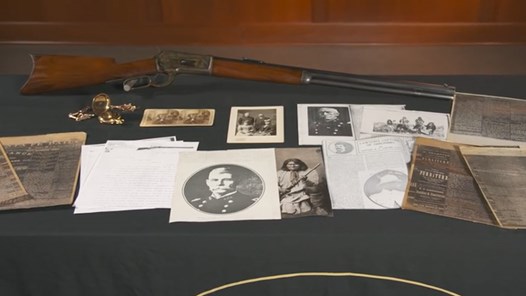
Before Sewall and Dow proceeded downriver, Roosevelt borrowed a pony and rode to the nearest ranch, where he hired the settler to drive his prairie schooner with “two bronco mares.” The settler “could hardly understand why I took so much bother with the thieves instead of hanging them offhand.” Roosevelt “soon found the safest plan was to put the prisoners in the wagon and myself walk behind with the inevitable Winchester.”

“Accordingly I trudged steadily the whole time behind the wagon through the ankle-deep mud. It was a gloomy walk. Hour after hour went by always the same, while I plodded along through the dreary landscape – hunger, cold, and fatigue struggling with a sense of dogged, weary resolution….”


“So, after thirty-six hours’ sleeplessness, I was most heartily glad when we at last jolted into the long, straggling main street of Dickinson, and I was able to give my unwilling companions into the hands of the sheriff. Under the laws of Dakota I received my fees as a deputy sheriff for making the three arrests, and also mileage for the three hundred odd miles gone over – a total of some fifty dollars.”

That Roosevelt went to such lengths to bring these three criminals to justice was uncommon in his time and place. Such magnanimity was not overlooked by the captives. Writing to Roosevelt from prison some time later, Mike Finnigan closed a letter, “P.S. Should you stop over at Bismarck this fall make a call to the Prison. I should be glad to meet you.”

Categories
HUH! Leadership of the highest kind Manly Stuff Our Great Kids Real men Soldiering Some Red Hot Gospel there! The Green Machine This great Nation & Its People War

One of my few real heroes! General Matthew B. Ridgway

Matthew B. Ridgway stepped into a freezing Korean command bunker in January 1951, looked at a wall map covered in retreat arrows, and made a decision that stunned every officer in the room. The United Nations forces were outnumbered, outmaneuvered, and collapsing, yet Ridgway calmly said the collapse would end tonight. Then he clipped a grenade to his chest harness and walked toward the front.
When he took command of the Eighth Army, morale was broken and casualties were rising.
Officers whispered that the war was already lost.
Ridgway refused to accept it.
He visited wounded soldiers at field stations and asked what went wrong.
They told him leadership had vanished from the battlefield.
He promised to fix it.And he did it the only way he believed in: by showing up under fire.
Ridgeway traveled to front line foxholes where temperatures dropped below zero and Chinese forces attacked at night with overwhelming numbers.
He carried no illusions.He carried grenades, a Bible, and the belief that soldiers follow example, not slogans.
Men said the sound of his boots in the snow changed entire units.If Ridgway appeared at dawn, it meant the line would hold.
He reorganized divisions, replaced timid commanders, and restored the offensive mindset.
When the Chinese launched their Fourth Phase Offensive in early 1951, Ridgway countered with precision.
He ordered tactical withdrawals to stretch enemy supply lines, then struck with concentrated artillery and air power.
His decisions stabilized the front and forced Chinese forces back north, reversing weeks of panic.
President Harry Truman took notice.When General Douglas MacArthur openly challenged civilian authority, Truman relieved him and appointed Ridgway to command United Nations forces.Ridgway accepted without theatrics.
He viewed the job as duty, not spotlight.
Under his leadership, defensive collapse turned into a balanced stalemate that prevented a wider war and saved thousands of lives.
He refused pressure to escalate into China because he understood the cost.
He believed in victory, but never in reckless victory.
After Korea, Ridgway became Army Chief of Staff in 1953, where he argued against expanding conflicts without clear purpose.
He kept a framed note in his office.It read: “No soldier’s life is expendable. No mission justifies waste.”
Matthew B. Ridgway never chased headlines.He chased responsibility.
He took broken armies, broken plans, and broken morale and rebuilt them with presence, clarity, and courage.
Some generals win battles with strategy.
Ridgway won them by showing up where a commander was least expected and most needed.

Categories
Allies Hard Nosed Folks Both Good & Bad Leadership of the highest kind Soldiering

History Briefs: Field Marshal Bill Slim

Categories
Leadership of the highest kind

25 War Heroes You Probably Never Heard Of

Categories
Leadership of the highest kind Paint me surprised by this Soldiering Some Red Hot Gospel there! Stand & Deliver The Green Machine This great Nation & Its People

Some great news for the Green Machine!! Also kudos for the 11th Airborne

Categories
Leadership of the highest kind This great Nation & Its People War

General Of The Armies — Who Was General John J. Pershing?

Categories
Good News for a change! Hard Nosed Folks Both Good & Bad Leadership of the highest kind Manly Stuff One Hell of a Good Fight Our Great Kids Real men Soldiering Stand & Deliver The Green Machine This great Nation & Its People War

8 Rounds of Valor – The Story of Thomas Baker

Categories
Allies Leadership of the highest kind War

Horatio Nelson – Victor at Trafalgar

Categories
All About Guns I am so grateful!! Leadership of the highest kind Manly Stuff One Hell of a Good Fight Our Great Kids Paint me surprised by this Real men Soldiering Stand & Deliver The Green Machine This great Nation & Its People War

The Guns of General Norman Schwarzkopf

Its a pity that they were not given to West Point or the US Army Museum. But that’s just me! Grumpy

Categories
Hard Nosed Folks Both Good & Bad Leadership of the highest kind Manly Stuff Real men Soldiering The Green Machine This great Nation & Its People

Happy 140th Birthday Sir !

Now the real speech below:

Be seated.

Men, all this stuff you hear about America not wanting to fight, wanting to stay out of the war, is a lot of horse dung. Americans love to fight.

All real Americans love the sting and clash of battle. When you were kids, you all admired the champion marble shooter, the fastest runner, the big-league ball players and the toughest boxers. Americans love a winner and will not tolerate a loser. Americans play to win all the time. I wouldn’t give a hoot in hell for a man who lost, and laughed.

That’s why Americans have never lost and will never lose a war. The very thought of losing is hateful to America. Battle is the most significant competition in which a man can indulge. It brings out all that is best and it removes all that is base.

You are not all going to die. Only two percent of you right here today would be killed in a major battle. Every man is scared in his first action. If he says he’s not, he’s a goddamn liar. But the real hero is the man who fights even though he’s scared. Some men will get over their fright in a minute under fire, some take an hour, and for some it takes days. But the real man never lets his fear of death overpower his honor, his sense of duty to his country, and his innate manhood.

All through your army career you men have bitched about what you call ‘this chicken-shit drilling.’ That is all for a purpose—to ensure instant obedience to orders and to create constant alertness. This must be bred into every soldier. I don’t give a fuck for a man who is not always on his toes. But the drilling has made veterans of all you men. You are ready! A man has to be alert all the time if he expects to keep on breathing. If not, some German son-of-a-bitch will sneak up behind him and beat him to death with a sock full of shit.

There are four hundred neatly marked graves in Sicily, all because one man went to sleep on the job—but they are German graves, because we caught the bastard asleep before his officer did.

An army is a team. It lives, eats, sleeps, and fights as a team. This individual hero stuff is bullshit. The bilious bastards who write that stuff for the Saturday Evening Post don’t know any more about real battle than they do about fucking. Now we have the finest food and equipment, the best spirit and the best men in the world. You know, by God, I actually pity these poor bastards we’re going up against, by God I do.

All the real heroes are not storybook combat fighters. Every single man in the army plays a vital role. So don’t ever let up. Don’t ever think that your job is unimportant. What if every truck driver decided that he didn’t like the whine of the shells and turned yellow and jumped headlong into a ditch? That cowardly bastard could say to himself, ‘Hell, they won’t miss me, just one man in thousands.’ What if every man said that? Where in the hell would we be then? No, thank God, Americans don’t say that. Every man does his job. Every man is important.

The ordnance men are needed to supply the guns, the quartermaster is needed to bring up the food and clothes for us because where we are going there isn’t a hell of a lot to steal. Every last damn man in the mess hall, even the one who boils the water to keep us from getting the GI shits, has a job to do.

Each man must think not only of himself, but think of his buddy fighting alongside him. We don’t want yellow cowards in the army. They should be killed off like flies. If not, they will go back home after the war, goddamn cowards, and breed more cowards. The brave men will breed more brave men. Kill off the goddamn cowards and we’ll have a nation of brave men.

One of the bravest men I saw in the African campaign was on a telegraph pole in the midst of furious fire while we were moving toward Tunis. I stopped and asked him what the hell he was doing up there. He answered, ‘Fixing the wire, sir.’ ‘Isn’t it a little unhealthy up there right now?’ I asked. ‘Yes sir, but this goddamn wire has got to be fixed.’ I asked, ‘Don’t those planes strafing the road bother you?’ And he answered, ‘No sir, but you sure as hell do.’

Now, there was a real soldier. A real man. A man who devoted all he had to his duty, no matter how great the odds, no matter how seemingly insignificant his duty appeared at the time.

And you should have seen the trucks on the road to Gabès. Those drivers were magnificent. All day and all night they crawled along those son-of-a-bitch roads, never stopping, never deviating from their course with shells bursting all around them. Many of the men drove over 40 consecutive hours. We got through on good old American guts. These were not combat men. But they were soldiers with a job to do. They were part of a team. Without them the fight would have been lost.

Sure, we all want to go home. We want to get this war over with. But you can’t win a war lying down. The quickest way to get it over with is to get the bastards who started it. We want to get the hell over there and clean the goddamn thing up, and then get at those purple-pissing Japs.[a]

The quicker they are whipped, the quicker we go home. The shortest way home is through Berlin and Tokyo. So keep moving. And when we get to Berlin, I am personally going to shoot that paper-hanging son-of-a-bitch Hitler.

When a man is lying in a shell hole, if he just stays there all day, a Boche will get him eventually. The hell with that. My men don’t dig foxholes. Foxholes only slow up an offensive. Keep moving. We’ll win this war, but we’ll win it only by fighting and showing the Germans that we’ve got more guts than they have or ever will have. We’re not just going to shoot the bastards, we’re going to rip out their living goddamned guts and use them to grease the treads of our tanks. We’re going to murder those lousy Hun cocksuckers by the bushel-fucking-basket.

Some of you men are wondering whether or not you’ll chicken out under fire. Don’t worry about it. I can assure you that you’ll all do your duty. War is a bloody business, a killing business.

The Nazis are the enemy. Wade into them, spill their blood or they will spill yours. Shoot them in the guts. Rip open their belly. When shells are hitting all around you and you wipe the dirt from your face and you realize that it’s not dirt, it’s the blood and guts of what was once your best friend, you’ll know what to do.

I don’t want any messages saying ‘I’m holding my position.’ We’re not holding a goddamned thing. We’re advancing constantly and we’re not interested in holding anything except the enemy’s balls. We’re going to hold him by his balls and we’re going to kick him in the ass; twist his balls and kick the living shit out of him all the time. Our plan of operation is to advance and keep on advancing. We’re going to go through the enemy like shit through a tinhorn.

There will be some complaints that we’re pushing our people too hard. I don’t give a damn about such complaints. I believe that an ounce of sweat will save a gallon of blood. The harder we push, the more Germans we kill. The more Germans we kill, the fewer of our men will be killed. Pushing harder means fewer casualties.

I want you all to remember that. My men don’t surrender. I don’t want to hear of any soldier under my command being captured unless he is hit. Even if you are hit, you can still fight. That’s not just bullshit either. I want men like the lieutenant in Libya who, with a Luger against his chest, swept aside the gun with his hand, jerked his helmet off with the other and busted the hell out of the Boche with the helmet. Then he picked up the gun and he killed another German. All this time the man had a bullet through his lung. That’s a man for you!

Don’t forget, you don’t know I’m here at all. No word of that fact is to be mentioned in any letters. The world is not supposed to know what the hell they did with me. I’m not supposed to be commanding this army. I’m not even supposed to be in England. Let the first bastards to find out be the goddamned Germans. Some day, I want them to rise up on their piss-soaked hind legs and howl ‘Ach! It’s the goddamned Third Army and that son-of-a-bitch Patton again!’

Then there’s one thing you men will be able to say when this war is over and you get back home. Thirty years from now when you’re sitting by your fireside with your grandson on your knee and he asks, ‘What did you do in the great World War Two?’ You won’t have to cough and say, ‘Well, your granddaddy shoveled shit in Louisiana.’ No sir, you can look him straight in the eye and say ‘Son, your granddaddy rode with the great Third Army and a son-of-a-goddamned-bitch named George Patton!’

All right, you sons of bitches. You know how I feel. I’ll be proud to lead you wonderful guys in battle anytime, anywhere. That’s all