Category: Allies
I got my driver’s license at 15. I started my first job the following day. I’ve been working ever since. The epiphany that I could turn my time and toil into stuff—mostly guns—was transformational.
Some of those jobs sucked pretty bad. Others were frankly awesome. The best of the lot involved flying helicopters for Uncle Sam.
Friends describe me the luckiest man alive. That’s not hyperbole. God has been inexplicably good to me. That weird good fortune followed me throughout the military.
It is really expensive to train you to fly a helicopter. As a result, the Army typically puts you in one machine and leaves you there. I got to fly four. Flying an OH-58 Aeroscout single-pilot with the doors off was an E-ticket ride. However, as a card-carrying young stupid male, that can be a dangerous space indeed.
Ambrosia—Food of the Gods
I hopped an OH-58 to Ada, Oklahoma, not because there was some pressing tactical reason to be there. This was a training flight. I could have flown most anyplace I could reach on a bag of gas. I picked Ada because Big Bob’s Ribs was right down the road from the tiny little aerodrome. If you were paying taxes back in 1993, legit, thanks for that.
Big Bob’s was a whole building chock full of diabetes and heart disease. A bit shopworn yet sporting the most amazing grub, Bob’s exemplified everything that was righteous and wholesome about our great country. If America was a restaurant, it would be Bob’s.
Lunch was sublime as always. However, it was also a bit messy and a somewhat rough on the gut. As I dragged my stuffed carcass out of the place, I ponied up an extra quarter for a Charm’s Blow Pop to cleanse my palate. This I stuffed into the shoulder pocket of my flight suit.
Homeward Bound
I lit up the airplane and was headed back to Fort Sill in short order. I’d guess I was doing maybe 110 knots at perhaps a thousand feet. The air was cool, and so was I. Eventually I retrieved my Blow Pop.
The Blow Pop is nature’s perfect candy. Once you suck the solidified sugar off the thing, there remains a healthy slug of top-quality bubble gum. I discarded the stick into the slipstream (it was biodegradable) and lost myself in my reverie. In short order, I had pulled my mike boom out a bit and was happily blowing bubbles.
I had a decent bubble cooking when an unexpected crosswind zipped in from the side. The big sticky sphere burst unexpectedly, encasing my mike boom in tenacious gelatinous goo. A fair bit of it ended up on my face. Now I was in a bit of a spot.
Sticky Stuff
Fort Sill is the home of the field artillery, and it was looming large in the distance. My home base was what the Federal Aviation Administration refers to as a Restricted Area and for good reason.
Artillery rounds crisscrossed that space 24/7. To get home, I had to call up approach control and gain clearance into the restricted area. Failure to do so would run me afoul of the FAA and also put my cohabiting in the same space with all of those high explosive projectiles.
I meekly hit my transmit button, “Fort Sill approach control, this is Army copter 12345, how copy, over?”
Nothing. I tried another couple of times and got nothing back then, either. With each passing second, I had less go juice in the fuel tank. This was rapidly becoming not awesome.
Pilot Stuff
Some modern combat aircraft will almost fly themselves. The OH-58 was nothing like that. The 58 was more like a 3-dimensional motorcycle. You had to fly the machine constantly, or it would roll inverted and kill you.
With this in mind, I cinched down the collective friction, pinched the cyclic between my knees, and clawed madly at my gum-covered microphone. As I did so, the zippy little aircraft gradually tried to turn upside down.
Once my scout rolled far enough to make me nervous, I returned my attention to the flight controls and got things straightened out.
It took three or four iterations before I got enough gum off of my mike to be heard by the radar guys. By then I had bubble gum on my nose, in my eyebrows, all over my flight helmet, and coating my Nomex gloves. However, I could now communicate, albeit not terribly well.
The Promised Land
I got clearance across the impact area and into the airfield without difficulty. I shut down the airplane and expeditiously retreated to address my self-inflicted wounds. With my face liberally coated in gum, I looked a bit like a human pencil eraser.
The following day I reported to the Central Issue Facility and requested a fresh set of flight gloves. The pair I turned in looked like they had been dipped in Pepto Bismol. The long-suffering supply NCO inquired as to how they had gotten into this sordid state. I told him I didn’t want to talk about it. Had I been rightfully killed, I can only imagine what the accident investigators might have concluded.
Categories
This is Not THE END of NATO
Categories
Sunday Shoot-a-Round # 339

Libraries are typically considered to be fairly civilized, quiet spaces conducive to learning.
However, that is not always the case. Photo by Carol Highsmith.
Most folks reading this are likely grown-ups. We have jobs, mortgages, families and responsibilities. However, for guys at least, no matter your station or means, little is more reliably entertaining than a good fart story.
There I was, a second-year medical student. For the previous year and change, I had functionally lived in the library. I should have taken my mail there. In exchange for the absurd amount of time I had logged in that accursed place, I developed some super friendships and had been privy to some genuinely bizarre goings-on. One of the more memorable was a truly gripping tale of urban survival.
Cultural mores are regional. What might be socially appropriate in one part of the world is breathtakingly offensive elsewhere. Our hero in this case was a foreign student whose idea of what was acceptable behavior in public obviously differed somewhat from our own.
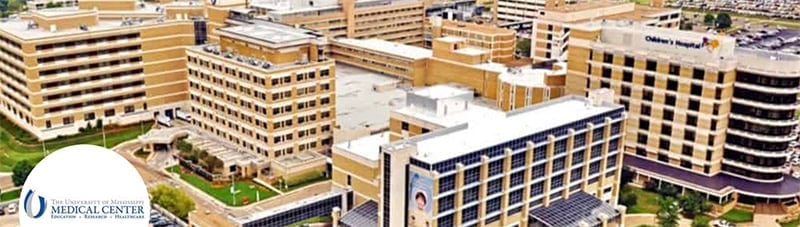
This is where I went to medical school. In addition to a great many radical experiences,
I was also once nearly farted to death by a foreign student in the school library.
The Guy
I was sitting peacefully with a half dozen fellow denizens in the library’s central upstairs study zone, my head buried in a pathology text, when the hapless villain strolled by. As might we all, I looked up, nodded, and smiled. These things I did without conscious thought.
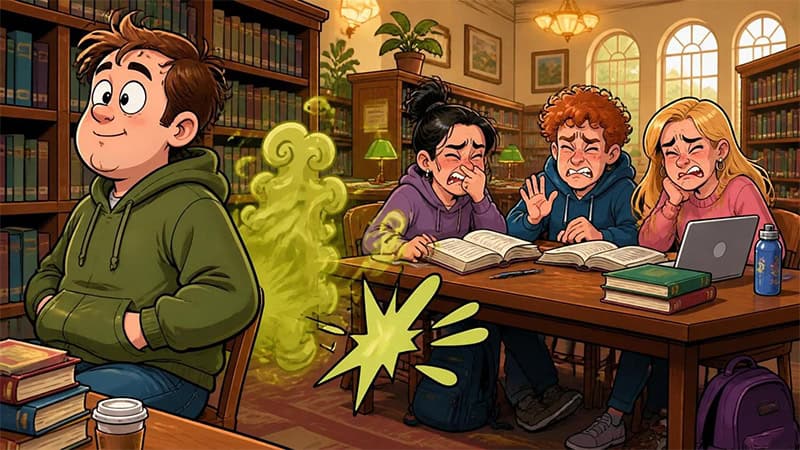
Without preamble, this vile, rotten dude responded by ejecting the most earth-shattering fart it has ever been my displeasure to survey. Witnesses to the event later attested that they observed books falling from shelves and overhead lights flickering in response to the deafening ejection. In retrospect, it was a miracle no one was killed.
The Thing
Flatus is the release of gas — predominantly methane, carbon dioxide, nitrogen and hydrogen sulfide — from the gastrointestinal tract. This gas is a byproduct of the chemical and enzymatic breakdown of our food. The typical adult human produces between 500 and 2000 milliliters of the rancid stuff per day. It is the hydrogen sulfide that produces the distinctive objectionable odor.
Given the volume and resonance of the discharge, I fully expected it to have blown a hole in his pants. Discreetly covering his backside with a sheaf of papers, Flatulence Man strolled blissfully on. He unleashed one more ground-shaking monster before calmly selecting a seat nearby. He then began to dig out his books nonchalantly. Our eyes burned, and our ears rang, yet this dude acted as if nothing of significance had occurred.
The Aftermath
For one pregnant trice, all remained still and peaceful. Not one sound broke the utter silence of the scene. Then, like that awesome moment during the demolition of a towering building between when the charges go off and the massive structure begins to topple, I gradually raised my eyes. There, seated directly across from me and now adjacent to the gentleman with terminal gas, sat my classmate.
His eyes, watering uncontrollably, met mine. I bit hard into my tongue, nearly drawing blood before I succumbed to the inevitable. We both then unleashed an uncontrolled torrent of pitifully-suppressed laughter. Mine felt as though it escaped through my nose and ears.
I stood up and quickly made my way to a quiet spot in the far corner of the library, now laughing so hard I thought my eyes might bleed.
My buddy met me moments later, and we both savored the hilarity of the experience. We replayed the details verbally so as to ensure that, should one of us not live through the evening, at least the epic story might survive. When we finally had regained some semblance of decorum, we purposefully made our way back to our seats.
No sooner had we resumed our places did the flatulent gentleman now retrieve one of those nasal suction devices used on congested infants and go to work zealously purging his sinuses.
The resulting snorking sound very nearly loosened the ceiling tiles. I looked on in amazement as my buddy veritably leaped from his seat, apparently fearing that some of the voluminous nasal discharge might inadvertently affix itself to his person.
All decorum was now hopelessly lost. My prospects for a profitable evening of study had perished along with it. I gathered my gear and made my way home, sincerely but fruitlessly wishing the rest of my library pals productive scholarship.
Ruminations
I don’t recall having seen the flatulent gentleman with the atypical personal hygiene habits again stalking the halls of the library after that fateful evening, his potentially lethal bowels ever ready to strike.
We all felt his scholarly pursuits might be best exercised in a better-ventilated area. Regardless, I sincerely expect to see his G.I. tract on display in a museum someday, either as a revolutionary new source of natural energy or a devastatingly effective chemical weapon system.
I think the school children of tomorrow should be able to appreciate such a remarkable medical oddity, albeit in a safe and controlled environment.
Regardless, I enjoy a certain deep and abiding kinship with Walt, Krista, Scotty, and the other survivors of that momentous evening.
Like survivors of an air crash, earthquake victims, or combat-hardened Navy SEALs, I feel that we have, by triumphing in the face of this unspeakable crucible, developed a bond that transcends the boundaries of most mortal experience.
Should I be so fortunate as to bump into one of these fellow physicians 30 years hence at some professional gathering or academic symposium, we will no doubt be reduced to tears over the retelling of that timeless evening when the mysterious stranger with the hyperactive bowels rendered the entire med school library uninhabitable.